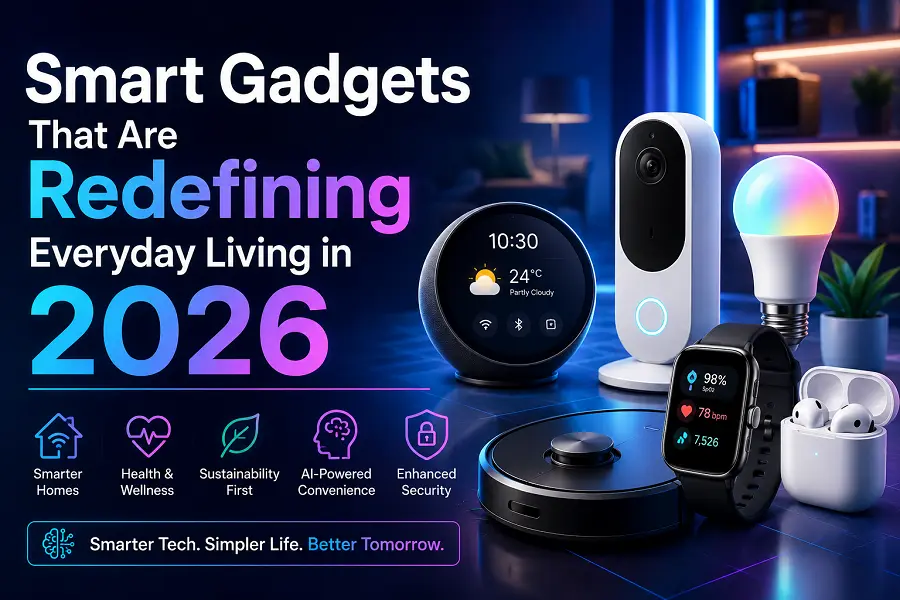

The landscape of consumer electronics is undergoing a fundamental shift. We are moving away from devices that function as passive, human-directed tools toward a new generation of intelligent platforms that act as proactive digital partners. In 2026, the “brain” behind your smartphone, wearable, and smart home is no longer just a set of pre-programmed rules; it is an agentic AI assistant capable of reasoning, context-awareness, and autonomous action.
The Shift to Ambient and Agentic Intelligence
Modern gadgets are evolving to prioritize intelligence over sheer processing speed. This transition is defined by the integration of agentic AI—systems that do not just wait for a prompt but understand the user’s intent and coordinate across multiple apps or services to achieve a goal.
-
On-Device Processing: By moving intelligence from the cloud to the device, AI assistants now operate with zero lag. Specialized hardware, such as Neural Processing Units (NPUs), allows your devices to handle complex reasoning locally, ensuring that sensitive personal data remains on your hardware rather than being sent to external servers.
-
Unified Ecosystem Orchestration: Today’s AI assistants bridge the gaps between previously siloed applications. Instead of manually navigating separate apps to book a flight, check your calendar, and send an email, a single agentic assistant manages these multi-step workflows by accessing your credentials and permissions to act on your behalf.
-
Contextual Awareness: Gadgets now fuse data from various sensors to understand your environment. A smart device can detect your physical activity levels, recent location, and upcoming schedule to adjust its own behavior—such as muting notifications or proactively suggesting helpful information—without requiring you to ask.
-
Predictive Adaptation: Rather than reacting to commands, modern assistants use historical data to anticipate needs. Whether it is adjusting the climate in a room before you enter or pre-loading the tools you need for your daily morning routine, the assistant functions as a silent, efficient background partner.
Transforming Everyday Gadgets into AI Platforms
The definition of a gadget has expanded significantly as AI becomes the central nervous system for everyday hardware.
-
Next-Generation Smartphones: These are no longer just communication tools; they are orchestration platforms. Modern chipsets allow phones to manage connections with wearables and smart home systems, effectively becoming the primary hub for your entire digital environment.
-
Health-Focused Wearables: Devices like rings and smartwatches have transitioned into diagnostic partners. By analyzing biometric trends in real-time, they provide proactive health insights and early warnings, turning raw data into actionable wellness interventions.
-
Spatial Computing Glasses: Sleek, lightweight AR glasses are replacing handheld screens for information access. By using generative voice control and real-time visual recognition, they overlay navigation, translations, and digital workspaces onto the physical world.
Maintaining Privacy and Performance
The transition to agentic AI requires a careful balance between utility and control. As assistants take on more responsibility, manufacturers are implementing stricter security standards. This includes localizing AI workloads, which improves privacy by keeping biometric and behavioral data off the web. Furthermore, the efficiency of these systems is a key competitive differentiator; the most advanced gadgets in 2026 are those that can perform deep, multi-step reasoning while maintaining long battery life, thanks to hyper-efficient NPU architecture.
Conclusion
The integration of AI assistants into modern hardware is effectively turning our devices into personalized agents. This evolution simplifies complex digital interactions, turning a series of fragmented tasks into a fluid, automated experience. As this technology matures, our gadgets will become even more adept at navigating the complexities of our daily lives, freeing us to focus on higher-level decision-making while the “brains” in our pockets handle the logistics of the modern world.
Frequently Asked Questions
What makes an AI assistant “agentic”?
An agentic assistant goes beyond answering questions; it can set goals, make independent decisions, and execute multi-step tasks across different apps to complete a project without constant human intervention.
Why is on-device AI better than cloud-based AI?
On-device AI offers faster, low-latency performance and significantly higher privacy because your personal data, biometrics, and habits do not need to be uploaded to a remote server for processing.
Will AI assistants eventually replace apps?
As AI assistants gain the ability to orchestrate workflows across multiple software services, they may reduce the need for users to open individual apps for routine tasks, serving as a unified interface for digital activities.
How do modern gadgets stay efficient with all this AI processing?
Manufacturers are using dedicated, power-efficient chips like Neural Processing Units (NPUs) specifically designed to handle AI workloads without draining the device’s battery as quickly as a general-purpose processor would.
Can I trust my gadgets to perform tasks autonomously?
Modern AI systems include strict identity and permission management. You remain the orchestrator, granting your assistant specific credentials and boundaries to ensure it only performs tasks you have explicitly authorized.