The global software market in 2026 is defined by a fundamental transition: the move from passive, static digital tools to autonomous, AI-native platforms. As the market valuation approaches the trillion-dollar threshold, growth is driven not just by adoption, but by the integration of computational intelligence into every layer of business operations. Software is no longer merely a system of record; it has become a system of execution.
The State of the Software Market
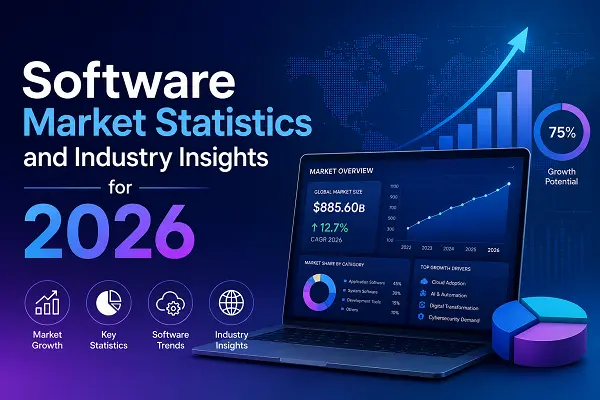
Industry expansion is characterized by a shift toward cloud-based architectures and consumption-based economic models. The following statistics reflect the current maturity and trajectory of the sector:
-
Market Growth Velocity: The global software market is experiencing a double-digit compound annual growth rate, with enterprise software remaining the dominant segment, accounting for over one-quarter of total market share.
-
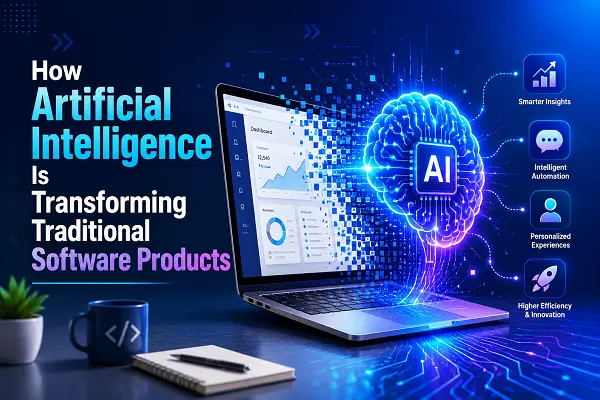
The AI-Native Shift: Integration of task-specific AI agents into enterprise applications has reached critical mass, with nearly half of all new enterprise software deployments incorporating autonomous, agentic workflows.
-
Democratic Development: Low-code and no-code platforms now power a significant majority of new internal business applications, allowing non-technical teams to bypass traditional development bottlenecks.
-
FinOps Necessity: With usage-based pricing becoming standard, spending on AI-powered applications has surged, necessitating new financial operations (FinOps) disciplines to manage budget volatility and cloud consumption costs.
Strategic Shifts in Software Development
The methodology behind building software has evolved to prioritize reliability and speed. Organizations are moving away from monolithic legacy systems to modular architectures that support rapid iteration.
-
Platform Consolidation: Businesses are aggressively replacing fragmented “point solutions” with unified platforms. This centralization reduces administrative overhead, minimizes security risks, and provides a single source of truth for cross-departmental operations.
-
Outcome-Based Pricing: Pricing models are shifting from rigid, per-seat subscriptions to models based on value and actual usage. This ensures that organizational spending aligns directly with the measurable outcomes—such as time saved or processes automated—rather than license counts.
-
Governance as a Differentiator: Security, data lineage, and auditability have become core product features. Enterprises now evaluate software vendors based on their ability to provide transparent AI governance and model explainability.
-
Domain-Specific Intelligence: Success is increasingly found in “vertical SaaS,” where platforms are built with deep, industry-specific knowledge. These systems outperform generic tools by embedding decision-making logic tailored to specific regulatory and operational environments.
The Future of Operational Intelligence
Looking ahead, the divide between organizations utilizing “AI-enabled” tools and those relying on “AI-native” platforms will continue to widen. AI-enabled products add superficial features to traditional codebases, while AI-native systems are built from the ground up to orchestrate autonomous agents. Competitive advantage in 2026 belongs to businesses that prioritize observability, fault tolerance, and the seamless integration of AI into their core infrastructure.
Conclusion
The 2026 software landscape is characterized by a focus on high-performance execution and operational agility. Businesses that succeed in this environment are those that treat their software stack as a dynamic partner. By moving toward composable architectures and prioritizing platforms that offer both autonomous intelligence and rigorous security governance, organizations can transform their technology investments into engines for sustainable growth and efficiency.
Frequently Asked Questions
What is the most significant change in SaaS pricing for 2026?
The shift from per-seat pricing to usage-based and outcome-driven models. This aligns costs with actual consumption, though it requires stronger financial oversight to manage potential budget volatility.
Why are businesses moving away from point solutions?
Point solutions create data silos and administrative bloat. Consolidating into unified platforms simplifies vendor management, improves security, and ensures consistent data quality across the organization.
How does “AI-native” software differ from traditional software?
AI-native software is designed with autonomous agents and data-driven intelligence at its core. Traditional software is code-based and static, whereas AI-native systems adapt to user behavior and execute tasks autonomously.
What is the role of FinOps in the current market?
FinOps is now essential for managing the cost of AI usage. With usage-based pricing, companies must monitor consumption patterns in real-time to avoid “bill shock” and ensure their AI investment provides a clear return on investment.
How do low-code platforms impact enterprise IT?
Low-code platforms shift the role of IT from primary developers to governance leaders. They allow business units to build their own tools, while IT teams focus on maintaining security, compliance, and architectural standards.