
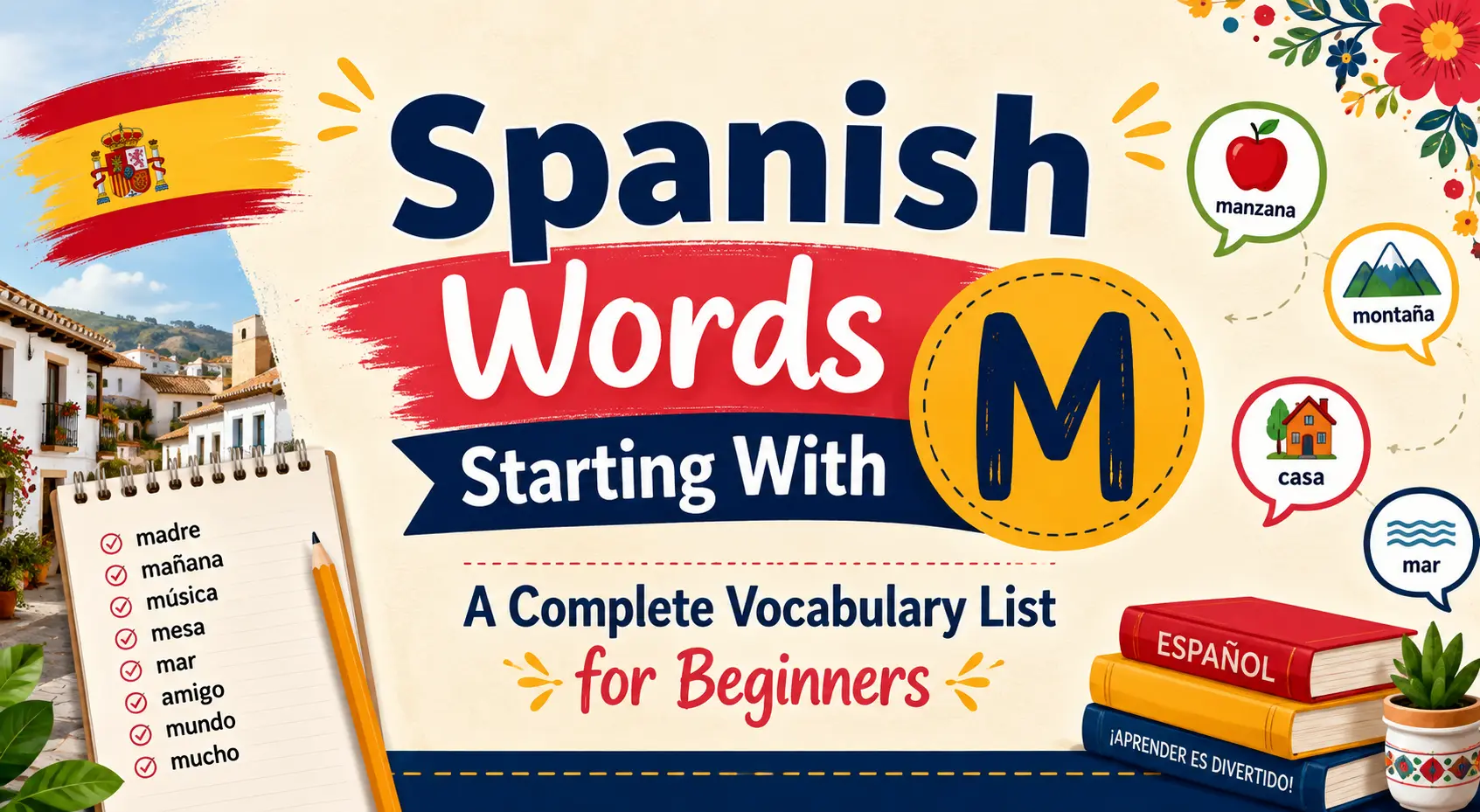
I still remember the first time I tried ordering food in Madrid and completely blanked on the word for “apple.” My brain landed on manzana about ten seconds too late, right after the waiter had already walked away with my very confused order of “the red fruit thing, please.” Small moments like that taught me something useful: the letter M carries an unusual amount of weight in everyday Spanish. Months, food, family members, feelings — a huge chunk of daily conversation runs through M words.
So instead of giving you a random dictionary dump, this guide is built the way I’d actually teach a beginner: grouped by real use, with pronunciation notes, and a few honest warnings about words that trip people up.
Why M Words Deserve Their Own Study Session
Spanish learners usually memorize vocabulary alphabetically because textbooks are organized that way, not because it’s the smartest method. But M is a bit of an exception. Words that start with M in Spanish show up constantly — mesa (table), madre (mother), mucho (a lot), mañana (tomorrow/morning). If you’re building a beginner vocabulary list, front-loading M words actually gives you a strong return on your study time, because you’ll hear them in nearly every conversation, menu, and Google Maps search.
There’s also a practical reason: a good number of Spain’s cities, regions, and monuments start with M, and business owners or travel writers targeting a Spanish-speaking audience need these terms correct — misspelling Málaga or Madrid looks careless.
Common Spanish Words That Start With M (Everyday Vocabulary)
Here’s a working list I’d hand to a student in week two or three of learning Spanish. I’ve kept pronunciation notes simple — no phonetic alphabet, just how it sounds to an English speaker’s ear.
| Spanish | English | Pronunciation tip |
|---|---|---|
| mano | hand | MAH-no |
| mesa | table | MEH-sa |
| madre | mother | MAH-dreh |
| mañana | tomorrow / morning | mahn-YAH-na |
| mucho | a lot / much | MOO-cho |
| mundo | world | MOON-doh |
| mujer | woman | moo-HAIR |
| mar | sea | mahr |
| mes | month | mess |
| miedo | fear | mee-EH-doh |
| museo | museum | moo-SEH-oh |
| música | music | MOO-see-ka |
| maleta | suitcase | mah-LEH-tah |
| mochila | backpack | moh-CHEE-lah |
| medicina | medicine | meh-dee-SEE-nah |
A quick note from experience: mañana trips people up because it means both “tomorrow” and “morning” depending on context. “Nos vemos mañana por la mañana” literally translates to “See you tomorrow in the morning,” and yes, native speakers say it exactly like that without blinking.
Adjectives in Spanish That Start With M
Adjectives are where beginners start sounding less like a phrasebook and more like an actual person, because you use them to describe how you feel, what something looks like, or how a situation went. Here are the ones worth memorizing early:
- malo/mala – bad
- mejor – better
- mayor – older / bigger
- menor – younger / smaller
- moderno/moderna – modern
- maravilloso/maravillosa – wonderful
- molesto/molesta – annoying, bothered
- mojado/mojada – wet
- maduro/madura – mature, ripe
- mismo/misma – same
One thing I always tell students: don’t skip mayor and menor. They don’t just mean “older/younger” — they’re also used for comparative size and importance, like “la mayor parte” (the majority) or “de menor importancia” (of lesser importance). Miss that nuance and you’ll misunderstand a lot of formal writing, news articles, and legal documents.
Places in Spain Starting With M
If you’re writing about travel, real estate, or Spanish culture, getting these place names right matters — both for accuracy and for SEO, since people search for these terms with specific spelling.
- Madrid – the capital, obviously, but worth noting it’s also one of Europe’s highest-elevation capital cities
- Málaga – coastal city in Andalusia, birthplace of Picasso
- Mallorca – the largest of the Balearic Islands
- Menorca – the quieter, less touristy Balearic sibling
- Murcia – a region and city in the southeast, known for its produce
- Marbella – upscale resort town on the Costa del Sol
- Melilla – a Spanish autonomous city on the North African coast, which surprises a lot of people who assume all of Spain is in Europe
- Mérida – historic city in Extremadura with some of the best-preserved Roman ruins in the country
I’ll be honest — Melilla catches people off guard every time I mention it in a conversation about “words that start with M in Spanish” as a places category. It’s genuinely part of Spain, sitting on the Moroccan coast, and it’s a good trivia point if you’re writing content for a Spanish-culture audience.
Family and Relationship Words With M
Family vocabulary is usually one of the first units in any Spanish course, and M is loaded here too:
- madre – mother
- marido – husband
- mujer – wife (same word as “woman,” context tells you which)
- madrina – godmother
- medio hermano / media hermana – half-brother / half-sister
- mellizos – twins (fraternal)
That double meaning of mujer (woman/wife) confuses a lot of beginners the first time they hear “Mi mujer llegó tarde” and wonder why a stranger is talking about “his woman” instead of “his wife.” Context does the heavy lifting in Spanish more than English learners expect.
Verbs Starting With M You’ll Actually Use
Vocabulary lists tend to skip verbs, which is a mistake, because verbs are what let you build actual sentences.
- mirar – to look
- mover – to move
- morir – to die
- mentir – to lie
- merecer – to deserve
- mostrar – to show
- mejorar – to improve
- manejar – to drive (mostly in Latin America) / to manage
- madrugar – to wake up very early
Madrugar deserves a mention because there’s no single-word English equivalent — it specifically means waking up before dawn, and Spanish speakers use it constantly, especially with the saying “Al que madruga, Dios le ayuda” (God helps those who wake up early — the Spanish version of “the early bird catches the worm”).
A Quick Word on Common Mistakes
I’ll flag two mix-ups I see constantly with English-speaking learners:
- Mucho vs. Muy — Mucho modifies nouns (“mucho dinero” = a lot of money), while muy modifies adjectives or adverbs (“muy caro” = very expensive). Mixing these up is one of the most common beginner errors, and native speakers will understand you, but it’s an instant giveaway that you’re still learning.
- Mayor vs. Más grande — Both can mean “bigger,” but mayor leans toward age or rank, while más grande is more literal about physical size. Saying someone is “más mayor” instead of just “mayor” is grammatically redundant but you’ll hear it in casual speech anyway — language doesn’t always follow the rulebook.
How to Actually Retain This List
Flashcards work, but they’re not the whole answer. What helped me more was labeling objects around my house with sticky notes in Spanish — mesa on the table, maleta on my suitcase — for about two weeks. It’s low-tech and a little embarrassing when guests visit, but the repetition sticks. Pair that with listening to Spanish news or podcasts and picking out M words when you hear them; you’ll notice mundo, mucho, and mismo show up constantly once you start listening for them.
Final Thought
There’s no shortcut to building vocabulary, and I won’t pretend a single list will make you fluent. But M words punch above their weight in Spanish — they cover family, geography, feelings, and daily objects all at once. Spend real time with this group before moving alphabetically through the rest, and conversations will start clicking faster than you’d expect.
FAQ
1. How many Spanish words start with the letter M?
There are thousands, ranging from everyday nouns like mesa (table) to technical and formal terms. This guide focuses on the most useful ones for beginners rather than trying to be exhaustive.
2. What is the most common Spanish word that starts with M?
Mucho (a lot/much) and más (more) are among the most frequently used, appearing constantly in daily speech.
3. What does “mañana” mean exactly?
It means both “tomorrow” and “morning,” depending on context. “Mañana por la mañana” means “tomorrow morning.”
4. Are there Spanish adjectives that start with M I should learn first?
Yes — start with malo (bad), mejor (better), mayor (bigger/older), and maravilloso (wonderful), since these appear in everyday descriptions.
5. What Spanish-speaking places start with M?
Madrid, Málaga, Mallorca, Menorca, Murcia, Marbella, Melilla, and Mérida are among the most notable in Spain.
6. Is Melilla really part of Spain?
Yes. It’s a Spanish autonomous city located on the north coast of Africa, bordering Morocco.
7. What’s the difference between “mujer” meaning woman and “mujer” meaning wife?
It’s the same word — Spanish uses context to differentiate. “Mi mujer” typically means “my wife” in casual speech.
8. What are common Spanish verbs starting with M?
Mirar (to look), mover (to move), mentir (to lie), mostrar (to show), and mejorar (to improve) are frequently used.
9. What does “madrugar” mean?
It means to wake up very early, typically before dawn. There’s no exact one-word English equivalent.
10. Is “mucho” the same as “muy”?
No. Mucho modifies nouns (mucho dinero = a lot of money), while muy modifies adjectives/adverbs (muy caro = very expensive).
11. What Spanish family words start with M?
Madre (mother), marido (husband), madrina (godmother), and mellizos (twins) are common examples.
12. How can I memorize Spanish M words faster?
Labeling household objects, listening to native audio, and using spaced-repetition flashcards all help — combining methods works better than relying on one.
13. Do Spanish M words differ between Spain and Latin America?
Some do. For example, manejar means “to drive” in most of Latin America, while Spain more commonly uses conducir.
14. What’s a good beginner sentence using multiple M words?
“Mi madre compró una mesa nueva mañana.” (My mother is buying a new table tomorrow.) — it naturally uses several M words together.
15. Are there Spanish words that start with M that don’t exist in English?
Yes — madrugar and sobremesa (not M, but a close cousin) both describe cultural concepts without direct English translations, which is part of what makes vocabulary study so interesting