
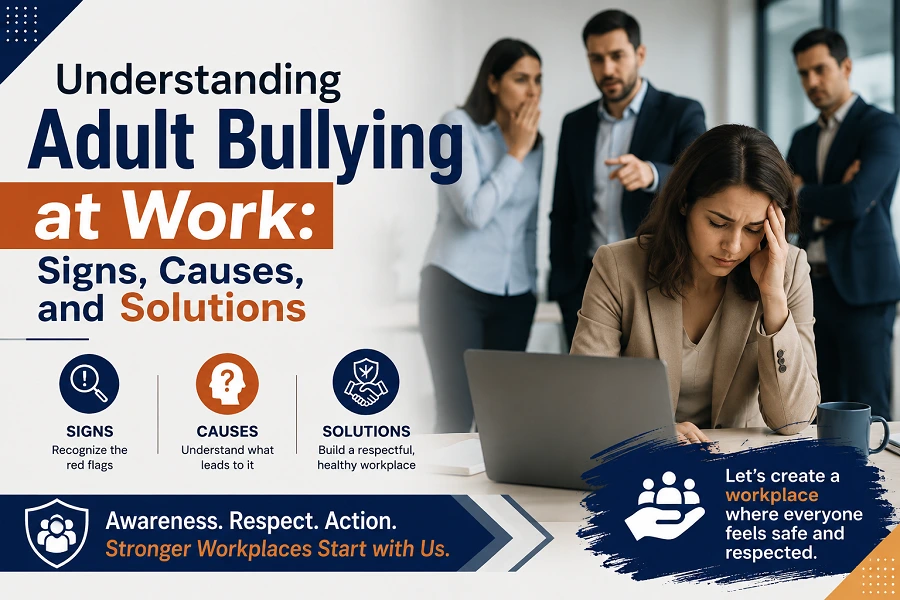
It Doesn’t Look Like Playground Bullying — That’s the Problem
Ask most people what bullying looks like, and they’ll picture a schoolyard scene. Someone bigger, someone smaller, a shove near the lockers. Nobody pictures a project manager who “forgets” to invite you to the meeting where your work gets discussed. Or a colleague who makes a joke at your expense in front of the whole team, then says “relax, I’m kidding” the second you react.
That’s exactly why adult bullying at work slips past so many people, including HR departments. It’s quieter. It’s dressed up in professional language. And it’s a lot more common than most workplaces want to admit — a 2021 survey by the Workplace Bullying Institute found that roughly 30% of U.S. employees have experienced abusive conduct at work firsthand, with another 19% witnessing it happen to someone else.
I’ve sat in enough team meetings to have seen versions of this play out — the manager who publicly “jokes” about someone’s mistakes every single standup, the senior employee who excludes a new hire from every informal lunch. Nobody called it bullying. Everyone just quietly accepted it as “how things are” on that team. That silence is usually the first sign something’s wrong.
What Adult Bullying at Work Actually Looks Like
Adult workplace bullying rarely announces itself. It builds through patterns, not single incidents. Here’s what tends to show up:
- Persistent criticism that isn’t about the work. Feedback on your actual output is normal. Comments about your voice, your accent, how you dress, or your general competence as a person — repeated, week after week — is something else.
- Deliberate exclusion. Being left off emails, meetings, or group chats that directly affect your job isn’t an accident when it happens over and over.
- Undermining in front of others. Public correction, sarcastic “jokes,” or being talked over in meetings, especially when it never happens to anyone else on the team.
- Taking credit or shifting blame. Your ideas get repackaged as someone else’s. Mistakes that aren’t yours somehow land on your desk.
- Micromanagement used as control, not oversight. Constant monitoring that goes beyond what the role requires, often paired with impossible or shifting deadlines.
The common thread isn’t any single behavior — it’s the pattern and the power imbalance behind it. A one-off bad meeting isn’t bullying. A boss who consistently humiliates you and knows you can’t easily push back without risking your job? That’s different.
Why Do Adults Bully in the Workplace?
This is the question people ask once they’ve stopped denying the problem exists. Understanding why adults bully in the workplace doesn’t excuse it, but it does help you respond with clarity instead of just confusion.
Insecurity dressed as authority. A lot of workplace bullies are threatened by competence, not indifferent to it. Someone who fears being replaced or outshined sometimes tries to shrink the people around them instead of growing themselves.
Organizational culture rewards it. If a company promotes aggressive managers because they “get results,” and never questions how those results were achieved, bullying becomes a survival strategy that gets modeled and repeated.
Learned behavior. Some people manage others the way they were managed. If someone came up in a workplace where yelling and humiliation were normal, they may genuinely not register their own behavior as bullying.
Lack of consequences. This is the big one. Bullying persists in workplaces where nothing happens after it’s reported — or worse, where the person who reported it faces backlash instead. When there’s no real cost to the behavior, there’s no real incentive to stop.
Stress and burnout. Not an excuse, but a factor — people under chronic pressure with no outlet sometimes take it out on whoever’s easiest to target, often someone junior or someone who won’t fight back.
The Real Cost — Beyond Hurt Feelings
It’s tempting to file workplace bullying under “personality clashes” or “tough management style.” But research consistently links it to measurable harm: higher rates of anxiety and depression among targets, increased absenteeism, and — practically speaking — higher turnover costs for employers who lose good people rather than deal with the actual problem.
I’d also add something the surveys don’t always capture: the slow erosion of confidence. People who’ve been bullied at work often second-guess themselves in their next job too, even with a manager who’s perfectly reasonable. That aftertaste sticks around longer than the job does.
What You Can Actually Do About It
Here’s where a lot of advice gets vague — “just talk to HR” — without acknowledging that HR sometimes protects the company, not the employee. So let’s be specific.
Document everything, as it happens. Dates, times, exact words if you can recall them, and who else was present. A pattern is hard to dismiss when it’s written down; a single memory is easy to argue with.
Name it clearly when you respond. “That comment about my accent isn’t okay” lands differently than an awkward silence. You don’t have to be confrontational — calm and direct works better anyway.
Find out if the behavior is isolated to you. Quietly checking with a trusted coworker can tell you whether this is a personal vendetta or a pattern the bully repeats with multiple people. That distinction matters for how you escalate.
Escalate in writing. Emails create a paper trail that verbal complaints don’t. If HR’s response is weak, that written record matters later, whether internally or externally.
Know your limits. Sometimes the healthiest solution isn’t fixing the situation — it’s leaving it. That’s not failure. Staying in a toxic setup out of stubbornness rarely pays off the way people hope it will.
One caveat worth being honest about: not every reporting process works well, and not every company takes this seriously enough. I won’t pretend documentation and a calm conversation always fixes things — sometimes the healthiest move really is updating your resume while you handle it internally.
A Quick Word on Learning and Adapting in These Environments
Adult learning in the workplace isn’t just about new skills — it includes learning how to read a team’s dynamics and protect your own headspace. Adults tend to learn best through relevance and direct experience rather than abstract rules, which is exactly why one uncomfortable meeting teaches you more about a manager than any onboarding document ever could. If you’re in a role where you’re trying to figure out how to train adults in the workplace or build healthier team norms, modeling respectful conflict resolution matters more than any policy printed in a handbook.
The Bottom Line
Adult bullying at work isn’t rare, and it isn’t always obvious. It hides in “jokes,” in exclusion, in feedback that’s really just cruelty in professional clothing. Recognizing the pattern is the first real step — after that, it’s about documenting, naming it, and deciding what you’re willing to tolerate. No job is worth your mental health, no matter how good it looks on paper.
FAQs
1. What counts as adult bullying at work?
Repeated, intentional behavior meant to intimidate, humiliate, or undermine someone — verbal abuse, exclusion, sabotage, or public humiliation — especially when there’s a power imbalance involved.
2. Is workplace bullying the same as harassment?
Not always legally. Harassment often relates to a protected characteristic (race, gender, disability), which can trigger legal protections. Bullying can happen without that link, though the behaviors often overlap.
3. Why do adults bully in the workplace if they’re supposed to be mature?
Insecurity, learned behavior, organizational culture that rewards aggression, and a lack of consequences are the most common drivers — maturity doesn’t automatically override these patterns.
4. Can a manager be a bully even if they’re “just tough”?
Yes. There’s a real difference between high standards and personal attacks. Tough feedback focuses on the work; bullying focuses on the person.
5. What should I do first if I think I’m being bullied at work?
Start documenting incidents immediately — dates, details, witnesses — before you do anything else.
6. Does HR always help in these situations?
Not always. Some HR departments prioritize protecting the company. That’s why written documentation matters even if HR’s initial response feels inadequate.
7. Can workplace bullying happen between coworkers, not just bosses?
Absolutely. Peer-to-peer bullying is common, especially in competitive team environments or when management looks the other way.
8. How is adult workplace bullying different from being a difficult coworker?
Frequency and intent are key. A one-off bad interaction is friction. A repeated pattern designed to diminish you is bullying.
9. Are remote workers immune to workplace bullying?
No — it just shifts form. Being excluded from calls, getting curt or hostile messages, or being left out of decisions can all happen remotely too.
10. What are the long-term effects of workplace bullying?
Anxiety, depression, lowered self-esteem, and in many cases, lingering self-doubt that follows people into future jobs.
11. Should I confront the bully directly?
If it feels safe to do so, calm and direct pushback in the moment can work. If there’s a power imbalance or safety concern, documentation and escalation are usually safer first steps.
12. Can adult bullying at work lead to legal action?
It depends on jurisdiction and whether the behavior overlaps with protected-class harassment. A few U.S. states have anti-bullying workplace legislation in progress, though comprehensive federal protection still doesn’t exist.
13. How can companies actually prevent adult bullying at work?
Clear reporting policies with real consequences, training that goes beyond a slideshow, and leadership that models respectful behavior — not just a poster in the break room.
14. Is it normal to doubt myself after being bullied at work?
Very common. Bullying is designed to make the target question their own competence and judgment — that reaction doesn’t mean you’re overreacting.
15. When is it time to just leave the job?
When you’ve documented, reported, and escalated without meaningful change, and your mental health is visibly suffering — that’s usually the signal it’s time to prioritize yourself over the position.