
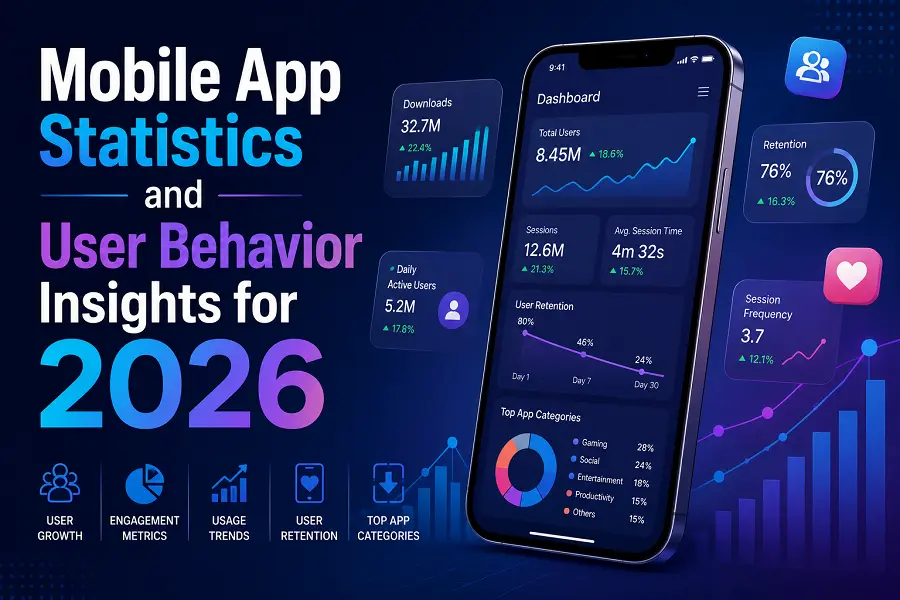
The mobile application market in 2026 has reached a pivotal level of maturity. With over 5 trillion hours spent in apps annually, the landscape is no longer defined by simple downloads, but by the depth of engagement and the speed at which apps solve specific user problems. Today, success is determined by an app’s ability to function as a responsive, intelligent companion rather than a static digital utility.
Key Market and Behavioral Shifts
User expectations have moved toward immediacy and high-level personalization. When an application fails to provide a seamless experience, the tolerance for technical friction is at an all-time low, leading to rapid uninstalls.
-
The Power of Personalization: AI-first design has become the industry standard. Users now expect interfaces to adapt to their individual habits, preferences, and even their current environment. Apps that dynamically rearrange layouts or surface predictive features based on real-time behavior see significantly higher retention rates.
-
The Subscription Dominance: Revenue models have shifted heavily toward weekly and monthly subscriptions. Weekly billing cycles, often paired with strategic free trials, have become the most effective way to secure long-term value, as they feel lower-risk to users while building consistent habit-forming patterns.
-
Zero-Click Navigation: Efficiency is the new hallmark of quality. Users are increasingly gravitating toward “zero-click” experiences where the app anticipates the next logical action—such as auto-filling data, surfacing context-aware shortcuts, or managing multi-step tasks autonomously.
-
The Rise of Agentic Workflows: Mobile apps are increasingly acting as agents. Rather than just displaying information, they now bridge the gap between various services to execute tasks, such as coordinating payments, scheduling, and logistics, through simple natural language prompts.
Retention Benchmarks and Engagement Patterns
Understanding how users drop off is essential for sustainable growth. In 2026, the battle for user attention is won or lost within the first few days of interaction.
-
Immediate Drop-Off: On average, nearly three-quarters of users do not return to an app by the second day after installation. This highlights that the “first-run” experience, or the onboarding process, is the single most critical window for demonstrating value.
-
Habit-Building Windows: By the end of the first week, retention typically stabilizes around 18%, and by day 30, it often settles into the single digits. Apps that successfully cross these thresholds are those that integrate into a user’s daily routine through meaningful, personalized notifications.
-
Cross-Category Variations: Retention is not uniform. Social media and communication apps naturally enjoy higher daily engagement, while utility and niche productivity tools require deeper integration into a user’s workflow to maintain long-term relevance.
-
The Value of Push Notifications: Strategic, context-aware push communication remains a primary driver for retention. Users who receive at least one relevant notification in their first 90 days are significantly more likely to remain active compared to those who do not.
Monetization and Revenue Trends
The economic structure of the app market has become increasingly winner-takes-all, with a small percentage of apps capturing the vast majority of consumer spending.
-
Trial-to-Conversion Tactics: The most successful monetization strategies now involve secondary onboarding—guiding users through premium features after initial usage—rather than locking the entire experience behind an immediate paywall.
-
Pricing Psychology: High-performing apps are moving toward granular pricing models, such as offering smaller, targeted micro-payments for specific features or short-duration upgrades, which can feel more accessible than rigid annual plans.
-
AI-Driven Discovery: AI is now used to analyze the exact moment a user is most likely to make a purchase. By triggering paywalls after a user achieves a “quick win” or completes a high-value task, developers are seeing higher conversion rates than those using generic, time-based prompts.
Conclusion
The mobile landscape in 2026 is driven by intelligence and efficiency. Users prioritize apps that save them time, adapt to their unique contexts, and offer clear, immediate value. Developers who succeed in this environment are those who leverage on-device AI to reduce friction, treat onboarding as a dynamic conversation, and employ flexible monetization models that align with how users actually behave.
Frequently Asked Questions
Why is weekly subscription revenue growing faster than annual?
Weekly plans feel lower-risk and more affordable to new users, allowing them to test the app’s value without a long-term financial commitment. This increases trial starts, which often lead to higher long-term retention.
What is the biggest reason for app uninstalls in 2026?
Technical performance remains the primary driver. If an app lags, crashes, or takes up too much storage space without providing clear utility, users uninstall it almost immediately.
How does AI change the way apps are built?
AI has moved from an add-on to a foundation. It allows for “vibe coding” and low-code development, meaning apps can be built faster and customized in real-time, removing the need for static, one-size-fits-all designs.
What is a “super app” and why is it significant?
A super app consolidates multiple services—such as banking, retail, and messaging—into one interface. This reduces “app fatigue” for the user and creates a more comprehensive data ecosystem for the developer.
How should I optimize my onboarding for retention?
Focus on achieving a “quick win” within the first session. Users need to see the primary value of your app immediately to justify keeping it installed beyond the first 24 hours.