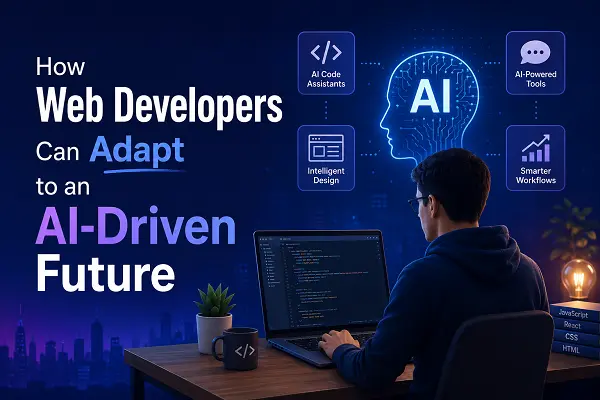
The web development landscape in 2026 has moved beyond simple automation. AI is no longer just a tool for generating boilerplate code; it is a collaborative partner that influences architecture, testing, and user experience design. For developers, the transition to an AI-driven future is not about competing with machine intelligence but about mastering the art of orchestration. Success today depends on elevating your role from a syntax-focused coder to a strategic system architect.
Pivoting Your Skill Set for the AI Era
The most valuable developers in 2026 are those who view code as a means to an end rather than the final product. As AI handles the repetitive heavy lifting of syntax and basic function creation, your expertise should shift toward higher-level problem-solving and oversight.
-
Prompt Engineering as a Core Competency: Mastering the ability to provide clear, structured context to AI agents is the new “coding.” Learning how to frame technical requirements, constraints, and edge cases ensures that AI-generated output is secure, performant, and maintainable.
-
System Architecture and Design: AI can generate functions, but it often lacks the holistic view of how components interact within a massive, complex codebase. Focusing on scalable system design, API orchestration, and database management keeps your work relevant and essential.
-
AI Tool Orchestration: Don’t rely on a single assistant. The modern developer’s toolkit involves “stacking” specialized agents—using one for UI layout generation, another for automated testing, and a third for security audits. Learning to manage these collaborative agents is a force multiplier for productivity.
-
Human-Centric UX Strategy: AI can optimize for engagement metrics, but it cannot replicate genuine human empathy or accessibility intuition. Developers who specialize in crafting inclusive, intuitive interfaces will remain in high demand because they bridge the gap between cold data and human needs.
The Developer’s New Workflow
Adapting to an AI-driven environment requires a fundamental change in how you approach the development lifecycle. Instead of starting with an empty IDE, you are now managing a stream of AI-assisted outputs.
-
Iterative Validation: Treat AI-generated code as a draft from a junior developer. Always review, test, and refactor. Your value lies in auditing for security vulnerabilities, performance bottlenecks, and adherence to business logic.
-
Test-Driven Development (TDD) Evolution: Use AI to write unit and integration tests based on your functional specifications. By offloading test generation, you can focus on defining robust test cases that ensure system reliability.
-
Context-Aware Integration: Learn to provide the right context to your AI tools. This means feeding them the relevant portions of your documentation, style guides, and existing codebase, which allows the AI to provide more accurate, project-specific suggestions.
-
Continuous Learning Loop: Stay updated on emerging models and frameworks. The speed of innovation in 2026 is rapid; keeping your technical foundation solid while experimenting with new AI-integrated stacks is the best way to remain adaptable.
Mastering AI Integration in Web Applications
The role of a developer in 2026 also encompasses integrating AI-native features directly into products. Understanding how to connect your frontend and backend to intelligent models is the next frontier of web development.
Focus on mastering the “four layers” of modern AI-powered applications: a responsive frontend (like React or Next.js), a secure backend API, a structured database for application data, and a vector database for handling semantic search and memory features. Understanding how to manage API costs, implement rate limiting, and protect user privacy when interacting with LLMs will distinguish a senior developer from a junior user. This is about building “living” websites that adapt to user behavior in real-time, moving beyond static interfaces to create deeply personalized digital experiences.
Conclusion
The evolution of web development is an invitation to do more impactful work. By embracing AI as a catalyst for efficiency, you gain the time and bandwidth to solve harder problems, design more elegant systems, and focus on the human impact of your digital products. Stay curious, focus on the fundamentals, and lean into your unique ability to provide human judgment where AI falls short.
Frequently Asked Questions
Is AI replacing junior web developers?
No, but it is changing their responsibilities. Entry-level tasks are being automated, meaning junior developers now need to focus on understanding system architecture and AI oversight earlier in their careers than ever before.
How do I ensure AI-generated code is secure?
You must treat AI suggestions as untrusted inputs. Always run security scans, perform manual code reviews for vulnerabilities, and implement automated testing pipelines to validate the logic before any code reaches production.
What is the most important skill to learn for 2026?
Beyond technical proficiency, it is the ability to “think in systems.” Knowing how to architect a scalable application and guide AI tools to build it is far more valuable than the ability to type out individual lines of code.
Do I need to be a machine learning expert?
Not necessarily. You do, however, need to be a skilled “integrator.” Understanding how to consume and manage AI APIs, handle vector data, and optimize prompts will make you highly effective without needing to build your own models.
How do I stay productive as tools evolve so fast?
Don’t try to master every new tool. Instead, focus on a core, stable stack and treat AI tools as modular components. By keeping your foundational knowledge strong, you can quickly adapt to new tools as they emerge.