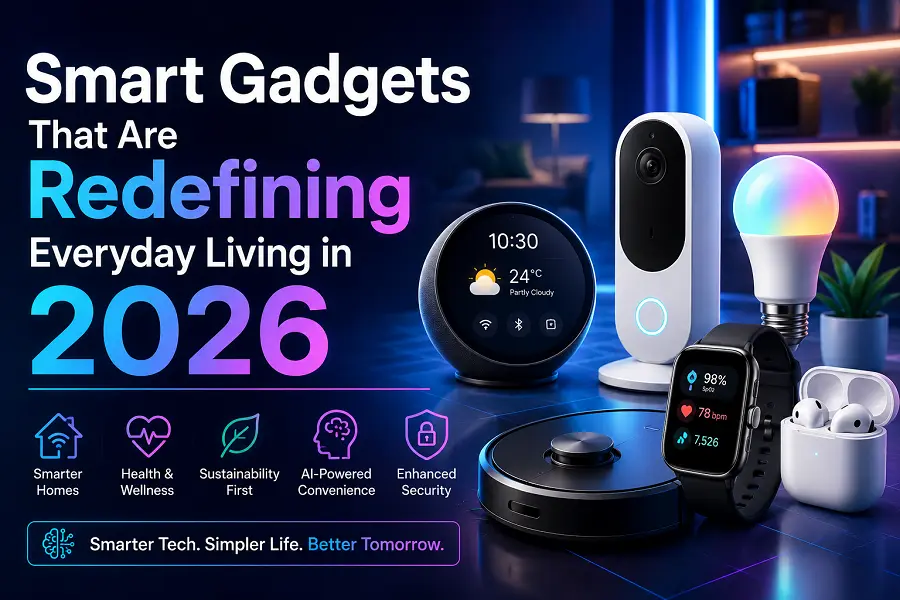

The landscape of consumer electronics is undergoing a profound transformation. We have moved past the era of incremental upgrades and are entering a period defined by ambient intelligence, where technology seamlessly integrates into our environment to become proactive rather than reactive. As 2026 unfolds, the devices we use are evolving from passive tools into intuitive digital companions that anticipate needs and adapt to habits.
The Rise of Ambient and Edge AI
Artificial Intelligence is no longer confined to cloud-based servers; it is now living directly on our devices. This shift to “on-device” or “edge” AI ensures that processing happens locally, providing instantaneous responses while keeping personal data private.
-
Proactive Personalization: Devices now analyze local biometric and behavioral data to adjust settings automatically, whether it is a thermostat learning your thermal preferences or a laptop optimizing power usage based on your specific workflow.
-
Zero-Lag Interaction: By removing the need to bounce data off a remote server, voice commands and real-time language translations happen in milliseconds, providing a fluid experience even when you are offline.
-
Enhanced Privacy: With AI models running locally on specialized neural processing units (NPUs), your schedule, health metrics, and voice data remain on your device, shielded from external web-based vulnerabilities.
Spatial Computing and the New Display Frontier
Bulky virtual reality headsets are rapidly giving way to sleek, wearable form factors. The industry is moving toward true spatial computing, where digital content overlays seamlessly onto the real world.
-
Smart Glasses 2.0: New augmented reality (AR) glasses mimic the look and weight of everyday streetwear. These frames pack high-resolution micro-displays into the lenses, allowing users to view navigation cues, translate foreign signs, or identify objects in real-time without holding a phone.
-
Advanced Foldable Displays: The fragility and visible “creases” that once plagued foldable tech have been engineered out. New dual-axis mechanical hinges and advanced flexible OLED materials allow devices to snap shut tightly and withstand years of daily use, making foldable laptops and tablets a new standard for portability.
-
RGB Color Technology: Television displays are shifting away from traditional white backlights. Newer RGB-based screens use individual red, green, and blue light sources for every pixel, resulting in unparalleled color accuracy, higher brightness, and significantly improved contrast ratios.
The Evolution of the Intelligent Home Ecosystem
Interoperability has become the defining characteristic of the modern smart home. Devices from competing brands now communicate through unified protocols, creating a cohesive “network of networks.”
-
Cohesive Ecosystems: Through standardized connectivity frameworks, lighting, security, and climate control systems function as a single, harmonious unit rather than a collection of disconnected apps.
-
Embodied AI: Beyond voice assistants, domestic robotics are taking on physical tasks. New cobots and autonomous drones, powered by vision-language-action models, can navigate complex home environments to assist with household maintenance and security.
-
Predictive Sustainability: Home electronics now emphasize energy efficiency as a core feature. Modern appliances use real-time energy monitoring to shift power-intensive tasks to off-peak hours, automatically reducing household utility costs without user intervention.
Conclusion
The trends of 2026 point toward a future where technology is increasingly invisible yet omnipresent. As hardware and software converge through edge AI, spatial computing, and smarter connectivity, the “next big thing” is less about a single revolutionary gadget and more about the holistic experience of living in a responsive, intelligent environment. For the tech enthusiast, the focus is shifting from chasing raw specifications to evaluating how these devices integrate, learn, and improve daily life through thoughtful automation and design.
Frequently Asked Questions
What is the difference between cloud AI and edge AI?
Cloud AI processes data on remote servers, which requires an internet connection and can introduce latency. Edge AI processes data locally on your device’s own hardware, offering faster performance, offline capabilities, and enhanced data privacy.
Are foldable phones still prone to breaking?
Not in 2026. Thanks to advancements in flexible OLED materials and durable dual-axis hinges, modern foldable displays are significantly more robust than previous iterations and no longer suffer from the prominent “crease” issues of the past.
How does the new RGB TV technology improve my viewing experience?
Unlike traditional TVs that use a backlight behind the screen, RGB TVs use tiny red, green, and blue lights to create the image directly. This allows for deeper blacks, much brighter highlights, and far more accurate color reproduction.
What are “Large Action Models” (LAMs) in robotics?
LAMs are a new class of AI that allows robots not just to “think” or understand language, but to perform tasks in the physical world. They enable robots to interpret surroundings, make independent decisions, and manipulate objects safely around humans.
Why is 2026 considered the year of “ambient” technology?
“Ambient” refers to technology that is always ready but does not demand constant attention. Devices in 2026 are designed to exist in the background, using sensors and AI to act on your behalf before you even need to pull out a phone or tap a screen.