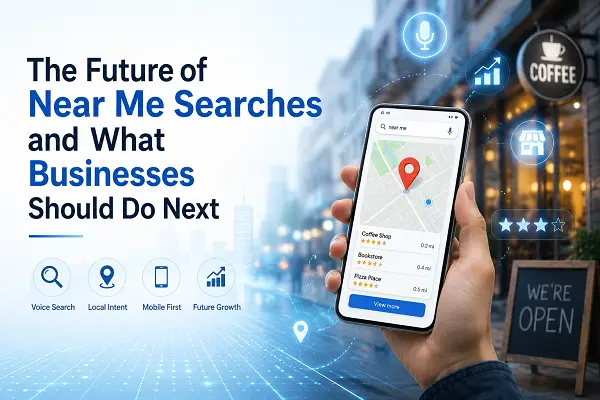
The phrase “near me” is disappearing from search bars, but hyper-local intent has never been stronger. Search engines no longer require explicit geographic prompts to understand that a user wants a local solution. Instead, location-based discovery relies on contextual understanding, predictive text, and conversational analysis. Surviving this shift requires businesses to look beyond basic proximity signals.
1. The Implied Proximity Shift: Context Over Keywords
Modern algorithms automatically apply structural location filters to everyday queries. A user typing “emergency plumber” or “best espresso” expects immediate local results without specifying a city or zip code.
-
Contextual Entity Mapping: Search engines connect a business entity to its physical coordinates by evaluating continuous background signals from mobile devices.
-
Zero-Click Conversions: Informational queries increasingly resolve directly inside search ecosystems, satisfying user intent via maps, click-to-call buttons, and real-time operational hours.
-
Intent Segmentation: Conversational phrasing shifts rankings from businesses with exact-match keywords to entities that explicitly prove they can fulfill immediate situational requirements.
-
Geospatial Clustering: Visibility is shrinking from broad municipal areas down to hyper-localized neighborhood clusters, making micro-regional prominence critical.
2. Advanced Adaptive Frameworks: Actionable Optimization Steps
As AI-driven search models and advanced search features synthesize data to recommend local entities, traditional on-page optimization must evolve to support structured data analysis.
-
Deploy LocalBusiness Schema at Scale: Inject highly detailed JSON-LD structured data into every location landing page. Explicitly define exact latitude and longitude coordinates, accepted payment types, and department-specific operational windows.
-
Optimize for Natural Conversational Language: Restructure digital assets to answer specific local questions. Focus content creation around multi-clause phrasing that people use during voice queries or complex search prompts.
-
Build Multi-Layered Topical Trust Signals: Establish localized digital authority by acquiring mentions from geographically relevant digital neighborhood spaces, regional publications, and local business organizations.
-
Audit Cross-Platform Geospatial Accuracy: Regularly verify map data, pins, and navigation coordinates across all major mapping frameworks, consumer directories, and vehicle navigation systems.
3. Behavioral Validation: The Power of Intent Fulfillment
Algorithmic systems place heavy emphasis on behavioral proof to determine if a business truly solves a searcher’s immediate problem. Consistently updating attributes helps match specific user preferences during filtered discovery.
To capture high-intent buyers, a digital footprint must reflect real-world activity. Consistent, high-resolution visual evidence of daily operations helps confirm ongoing physical legitimacy to crawling spiders. Furthermore, building topical prominence depends heavily on how a business manages its community feedback. Encouraging natural, descriptive reviews that detail specific services or products provided—and responding to those insights with clear, contextual vocabulary—validates expertise. This consistent operational transparency directly influences inclusion in complex AI summaries and maps.
Conclusion
The future of hyper-local discovery belongs to businesses that focus on structured relevance and verifiable operational activity. By aligning web architecture with implied intent, optimizing structural code, and accumulating real-world trust indicators, businesses can ensure continuous visibility when proximity matters most.
FAQs
Why are explicit “near me” keyword searches starting to decrease?
Search engines have grown sophisticated enough to assume local intent based on a device’s GPS data and past search history. Users no longer need to type geographic modifiers because localized results are served automatically.
How do AI-driven search overviews choose which local businesses to recommend?
AI systems scan the web for consistent location data, high-quality descriptive reviews, and clear structured data. They select entities that display the highest level of trust, direct contextual relevance to the query, and real-world activity.
Should multi-location businesses create separate landing pages for every area?
Yes. Every physical branch or service territory needs a dedicated, indexable URL containing location-specific structured schema, unique team details, accurate operating hours, and distinct local service descriptions.
What is the most critical technical element for local discovery today?
LocalBusiness structured data markup is vital. It acts as a direct data translation layer, providing search crawlers with verified operational details, exact geographic coordinates, and service parameters in an unambiguous format.
Does user engagement on map listings affect actual search visibility?
Yes. High interaction rates, such as requests for driving directions, phone calls, and direct text messages, act as strong behavioral validation signals that can boost a business’s regional prominence.