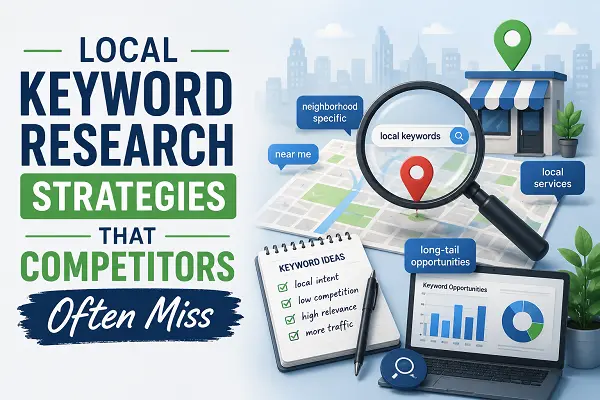
Standard search tools often miss the nuanced way people speak within specific neighborhoods. When businesses rely solely on high-volume search metrics, they overlook profitable, hyper-localized search traffic. True local optimization captures queries shaped by community identity, real-world geography, and immediate human intent.
1. Mining Hyper-Local Geospatial Vocabulary
Most marketers optimize for major city names and call it a day. However, residents rarely use official municipality terms when searching for immediate service providers. Uncovering the informal vocabulary of a region reveals untapped ranking opportunities.
-
Neighborhood Micro-Identifiers: Identify non-official district names, historic quarters, and localized estate titles that lack high search volume metrics but carry immense commercial intent.
-
Colloquial Regional Slang: Adapt content to match regional dialects and unique phrases used by residents to describe daily problems or common services.
-
Implicit Cross-Street Landmarks: Target phrases that combine a service with prominent local structures, major intersections, or popular public parks.
-
Transit Hub Associations: Optimize for keywords tied to commuter paths, subway terminals, and major highway exits where consumers seek convenience.
2. Deciphering Zero-Click and Conversational Search Patterns
The rise of voice search and mobile-first discovery has shifted search behavior from fragmented keywords into complete, natural phrases. Competitors miss these because typical software rarely categorizes them as high priority.
-
Extract Customer Service Dialogue: Review past email threads, support tickets, and live chat transcripts to pinpoint the exact phrases clients use to express their pain points.
-
Scrape Community Text Forums: Analyze localized digital message boards and neighborhood social groups to see how residents ask peers for recommendations.
-
Audit the “People Also Ask” Ecosystem: Map out the informational, transactional, and navigational questions that surface when main local terms are searched.
-
Target Mobile Proximity Queries: Focus on phrases that naturally occur when users are on the move, framing intent around immediate spatial availability.
3. Designing Contextual Content Frameworks
Once hidden keywords are uncovered, they must be integrated into an authentic website architecture. Forcing mismatched terms into generic pages destroys user trust and triggers search penalty algorithms.
Create dedicated landing pages that address distinct regional challenges rather than churning out cloned location pages with swapped city names. If a plumbing business targets an area known for historic homes, the keyword strategy should pivot toward old pipe restoration and specific architectural regulations. This structural relevance proves genuine local expertise to both search crawlers and prospective clients.
Conclusion
Dominating local search requires moving beyond generic keyword tools. By listening to how a community actually speaks, answering their distinct conversational questions, and building tailored contextual content, businesses can capture high-converting traffic that competitors completely look over.
FAQs
Why do standard keyword tools miss valuable local search terms?
Most software aggregates search data at a national or global level. They lack the granular capability to track low-volume, highly specific terms used within single neighborhoods or small communities.
What is the best way to find informal neighborhood names?
Study local real estate listings, community social groups, and regional news publications. Pay close attention to how residents describe boundaries and distinct districts in everyday speech.
Do “near me” keywords need to be written explicitly on a page?
No. Search engines use the real-time GPS location of the user to determine proximity. Optimize instead for specific geographic landmarks, zip codes, and neighborhood names to signal local relevance.
How do I prioritize low-volume local keywords?
Evaluate the commercial intent rather than the search volume. A phrase searched only ten times a month that targets a specific, urgent neighborhood need converts much higher than a generic city-wide term.
Can I use the same local keywords across multiple location pages?
Each location page must feature unique keyword variations tailored to that specific area. Using duplicate content with minor city swaps signals low-quality automation to modern search engines.