Enterprise software is undergoing its most radical architectural layout overhaul since the migration to cloud hosting networks. Business tools previously functioned as passive, transactional ledger sheets. Organizations depended on employees to manually input raw metrics, execute repetitive database updates, and bridge the operational gaps between disconnected software platforms.
The integration of advanced cognitive computing has permanently broken this legacy operational framework. Modern application infrastructure has transitioned from a passive workspace into an active operational intelligence layer. By embedding language models, deep learning pipelines, and multi-system automation directly into core architectures, business software now actively anticipates problems, designs solutions, and executes complex tasks with minimal manual oversight across the global economic landscape.
Vertical Specialization and Cross-Industry System Enhancements
The deployment of intelligent systems manifests differently within distinct market sectors, replacing generic code bases with highly specialized, domain-specific logic paths.
-
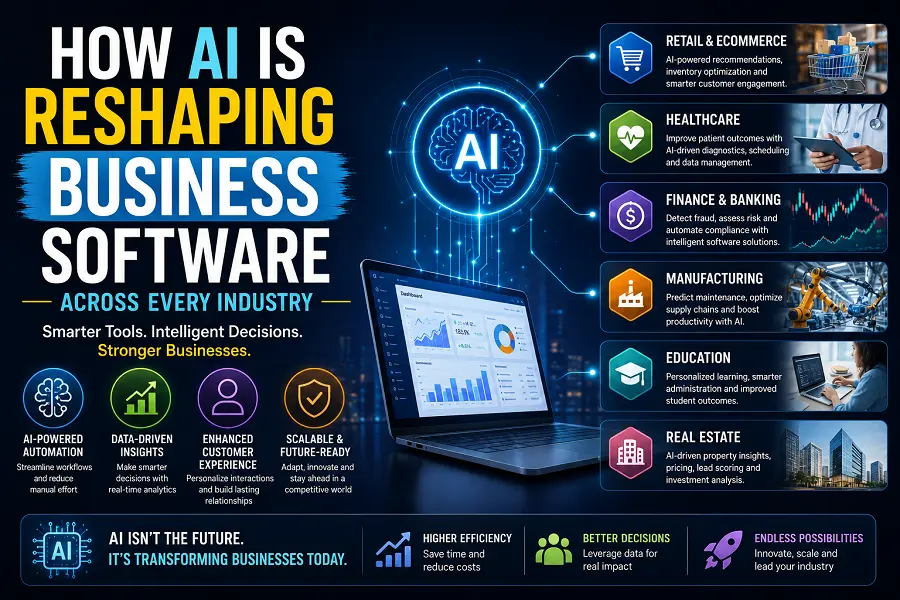
Healthcare Clinical Documentation Acceleration: Administrative platforms capture spoken ambient dialogue during patient examinations, translating unstructured conversations into compliant medical records instantly.
-
Financial Fraud and Risk Remediation: Transaction engines move beyond simple rule-based filters, tracking real-time behavioral anomalies to identify sophisticated digital forgery and identity theft.
-
Manufacturing Predictive Maintenance Protocols: Factory floor operating systems synthesize machine sensor vibration logs with past maintenance logs to schedule repairs before equipment failures occur.
-
Retail Supply and Inventory Calibration: E-commerce database software evaluates real-time market intent signals and geographic weather changes to automatically shift stock levels across regional distribution points.
Architectural Pillars of Modern Autonomous Business Networks
The practical evolution of modern business software is anchored upon advanced structural mechanisms that fundamentally alter how data is processed, verified, and commercialized.
-
Multi-Agent Operational Orchestration: Complex tasks are divided among specialized digital workers within the software suite, where a planning program organizes sub-tasks, assigns analytical duties to specialized modules, and monitors execution quality.
-
Intelligent Unstructured Document Processing: Advanced parsing engines extract deep context from unorganized files, corporate contracts, and handwritten receipts, turning chaotic information streams into structured, queryable data foundations.
-
Natural Language System Querying: Traditional point-and-click software navigation is replaced by conversational text commands, allowing managers to extract intricate cross-departmental reports using everyday syntax.
-
Continuous Adaptive Compliance Logs: Compliance tracking tools continuously scan shifting regional regulations, automatically rewriting system access protocols and updating internal risk management guidelines to prevent systemic exposure.
Redefining Human Output and Enterprise Growth Models
The deep integration of artificial intelligence within corporate software suites fundamentally alters the financial mechanics of corporate scaling. Historically, expanding a business required a matching linear expansion in operational headcount to manage the growing volume of administrative data, customer communications, and supply logistics.
Intelligent software breaks this historical dependency by providing unmatched operational leverage. When software platforms autonomously manage data categorization, initial client outreach, and first-level problem resolution, human responsibilities pivot completely toward specialized governance and strategic design. Teams dedicate their energy to managing exceptional edge cases, refining algorithmic boundaries, and executing high-impact creative tasks. This structural evolution allows expanding organizations to dramatically increase their total transaction volume and market velocity while maintaining stable, highly predictable overhead expenses.
Conclusion
The evolution of AI-powered business software marks a structural shift from manual task execution to completely automated operational orchestration. By transforming software applications into proactive partners, modern enterprises build an incredibly flexible foundation capable of rapid scaling, bulletproof compliance, and continuous data-driven evolution.
Frequently Asked Questions
What is the main difference between traditional business software and AI-native software?
Traditional tools require human users to manually input data and create rigid, hard-coded operational paths, whereas AI-native systems continuously learn from corporate data to automate multi-step processes independently.
How does embedded AI software maintain absolute corporate data privacy?
Modern enterprise platforms rely on private cloud infrastructure and isolated data containers, ensuring your proprietary operational metrics are never exposed to public training networks or external corporate competitors.
Can non-technical team members safely configure automated software workflows?
Yes. Modern enterprise applications utilize natural language interfaces and low-code design spaces, allowing non-technical managers to build complex operational paths simply by typing clear, conversational business directions.
What is agentic AI within the context of corporate software applications?
Agentic AI refers to autonomous software programs that do not just assist a user, but independently plan multi-step workflows, navigate multiple corporate databases, and adapt their actions when unexpected system outcomes occur.
How can a business measure the direct financial return of upgrading to smart software?
Track the exact compression in production cycle times, the complete elimination of manual data correction steps, and the reduction in customer support resolution times, comparing those savings directly against licensing costs.