Selecting a primary artificial intelligence assistant has shifted from a casual trial of chatbot platforms to a critical strategic business decision. In 2026, the baseline capabilities of large language models have achieved parity regarding standard text generation and basic summarization tasks. The differentiating factor no longer relies on parameter size alone, but on how effectively an engine executes complex multi-step reasoning, real-time context integration, and specialized technical problem-solving.
For power users, developers, and digital strategists, utilizing the wrong model architecture introduces systemic inefficiencies into core workflows. Evaluating the current state of these systems requires stripping away corporate marketing hype to look closely at distinct performance markers across real-world enterprise operations.
Technical Architecture Strengths and Niche Superpowers
Every prominent model family operates on a unique algorithmic philosophy that optimizes for specific computational outcomes. Matching your specific operational demands to these distinct engineering advantages is the key to maximizing automated output value.
-
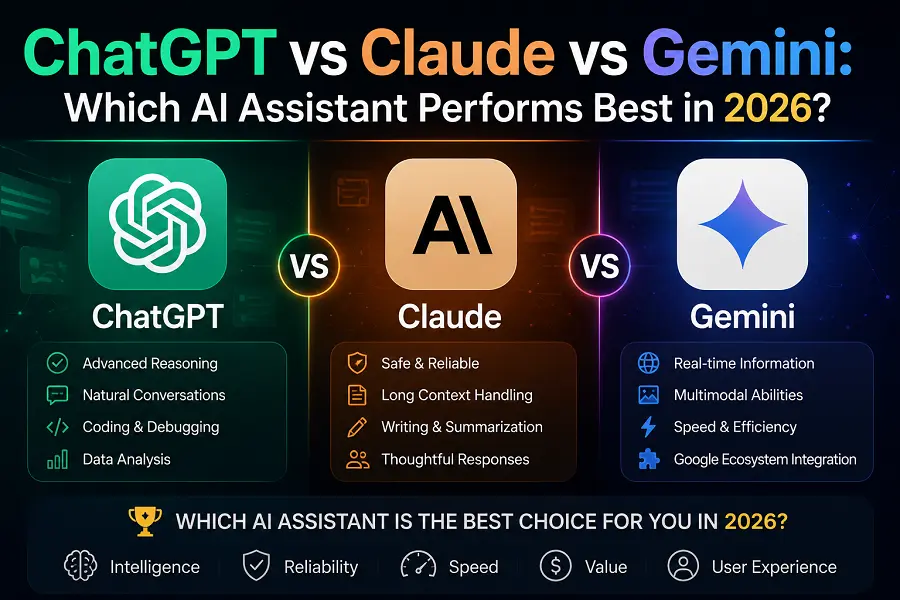
Claude (Anthropic Ecosystem): This framework remains the uncontested leader for deep analytical parsing, nuanced long-form narrative composition, and complex multi-file document reconciliation. Its internal attention layers capture subtle conceptual themes that other models often gloss over.
-
Gemini (Google Ecosystem): Built natively for multimodal operations, this engine dominates workloads requiring massive context window ingestion and instant, zero-latency connections to live, real-time index data streams.
-
ChatGPT (OpenAI Ecosystem): This platform excels as an agile, highly programmable engine for custom multi-agent execution, raw code compilation, and structured programmatic integration via robust, enterprise-grade developer pipelines.
Evaluating Specialized Execution and Processing Performance
Determining true model dominance requires testing how these cognitive engines perform under heavy analytical stress. When tasked with moving past conversational chit-chat into structural data manipulation, their performance paths diverge sharply.
-
Multi-Step Logical Reason Engineering: For advanced programming compilation, mathematical architecture debugging, and raw financial predictive logic modeling, OpenAI’s latest reasoning pipelines demonstrate a distinct edge in avoiding systematic logic failures.
-
Context Window Volume Maintenance: Anthropic and Google both process hundreds of thousands of data tokens simultaneously, but Gemini preserves internal memory integrity better over massive multi-hour text data uploads without dropping key thematic details.
-
Stylistic Human Variation Matching: Claude consistently avoids predictable programmatic transition loops and lookalike sentence lengths, generating structural explanations that require minimal manual human polishing to read organically.
-
Extensible Third-Party Plugin Connections: ChatGPT maintains the most mature framework for connecting custom automation workflows directly into external corporate software stacks, creating highly autonomous productivity loops.
The Strategic Decision Framework for Workflow Optimization
Maximizing the return on your artificial intelligence investments means abandoning the search for a singular, magic-bullet solution. High-performing digital operations increasingly utilize a diversified, multi-model approach that assigns specific tasks to the engine best equipped to handle them.
For example, a modern software content architecture team should utilize Gemini to run real-time market data gap analysis and instantly harvest rising technical query variations straight from live discovery networks. From there, those raw content blueprints are funneled into Claude to execute deep structural drafting and long-form prose synthesis, ensuring maximum readability and stylistic burstiness. Finally, the completed assets pass through ChatGPT to generate clean, programmatic schema markups and validate underlying API callback codes. This structural orchestration cuts down execution times while ensuring premium output depth.
Conclusion
No single artificial intelligence engine claims total dominance in 2026; performance supremacy depends entirely on your exact task profile. By deploying Claude for stylistic depth, Gemini for massive live-data ingestion, and ChatGPT for programmatic development, you unlock an elite, cross-functional automation engine.
Frequently Asked Questions
Which assistant writes code with the lowest error rate?
OpenAI’s advanced reasoning models within ChatGPT consistently lead in complex code compilation, displaying superior debugging patience and fewer algorithmic logic hallucinations across complex programming loops.
Can Gemini access current web info better than its competitors?
Yes. Because it is directly integrated into real-time indexation networks, Gemini synthesizes breaking world events, localized search trends, and changing industry variables faster and with fewer sourcing errors.
Which AI platform handles long PDF analysis most effectively?
Claude is highly superior for processing large text volumes, showing an unparalleled ability to compare disparate data sets and extract subtle narrative patterns from multi-thousand-page financial or legal documents.
Do all three AI tools follow identical content quality standards?
While their safety thresholds vary, their natural language processors all default to highly predictable patterns. Forcing a custom voice always requires custom prompt constraints.
Is it necessary to pay for subscriptions to all three assistants?
For standard administrative tasks, a single platform suffices. However, for specialized digital enterprises, maintaining access to both an analytical powerhouse like Claude and a programmatic utility like ChatGPT is highly beneficial.