Affiliate marketing is undergoing a quiet revolution. For years, the industry relied on manual processes: scraping keywords, drafting product roundups, hunting for high-commission programs, and manually inserting tracking links. Today, autonomous AI agents—software entities programmed to perceive their environment, make decisions, and execute multi-step tasks independently—are moving beyond simple text generation to handle entire operational loops.
This shift forces publishers and digital marketers to confront a critical question: Will autonomous AI agents completely replace traditional affiliate workflows, or will they simply redefine the human role within them?
How AI Agents Restructure the Affiliate Pipeline
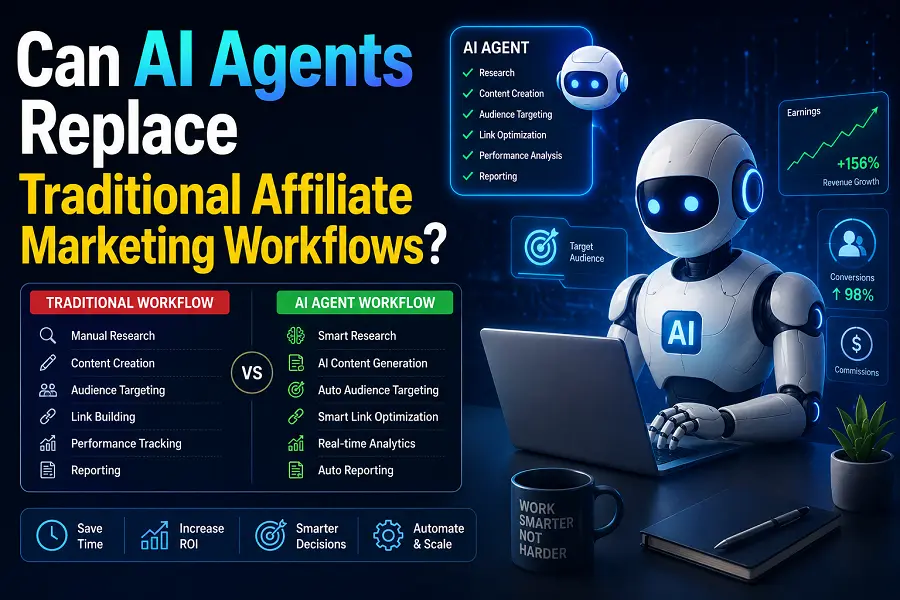
Traditional affiliate marketing requires balancing multiple creative and analytical roles. AI agents disrupt this by executing complex, multi-layered workflows without constant human prompts. Instead of a marketer manually jumping between analytics tools, keyword databases, and content dashboards, a single agent loop can monitor data trends and deploy changes autonomously.
The core areas undergoing the most significant automation include:
-
Dynamic Product Discovery: Agents monitor retail networks and affiliate networks simultaneously, automatically identifying breakout products before they saturate the market.
-
Contextual Link Injection: Instead of relying on static plugins, intelligent software analyzes user behavior and current inventory changes to update out-of-stock product links with active alternatives in real-time.
-
Predictive Trend Analysis: By parsing search patterns, social sentiment, and historical sales data, these systems predict shifting consumer preferences weeks before standard keyword research tools flag them.
-
Automated Regulatory Compliance: Agents audit thousands of historical review articles to ensure proper disclosure statements remain visible, protecting sites from algorithmic or legal penalties.
The Core Bottlenecks of Fully Autonomous Affiliate Systems
Despite their operational efficiency, AI agents cannot entirely eliminate the need for human oversight. Google’s evaluation systems heavily favor content that reflects First-Hand Experience and Expertise (E-E-A-T). Software can aggregate existing information, but it cannot physically unbox a product, stress-test a laptop, or experience the texture of a fabric.
The structural limitations keeping traditional human workflows relevant fall into distinct categories:
-
The Authentic Experience Gap: Audiences trust reviewers who have genuinely used a product. An AI agent can synthesize data sheets and user reviews, but it cannot offer genuine, subjective critique or original photography.
-
Algorithmic Homogenization: When multiple affiliate sites deploy similar autonomous agents to optimize for the same search intent, the resulting content becomes identical. Human insight breaks this echo chamber by introducing contrarian opinions and unique angles.
-
Relationship Management: High-tier affiliate success depends heavily on direct negotiation with brand managers for exclusive coupon codes, higher commission tiers, and flat-fee hybrid deals. Software cannot build these professional, trust-based networks.
The Hybrid Model: The Future of Affiliate Operations
The future does not belong to the purely manual marketer or the completely automated machine. Wealth generation in modern digital publishing shifts toward a hybrid operational framework. Humans pivot from being production line workers to acting as creative directors and editorial editors.
In this model, the AI agent serves as an advanced utility engine that handles the heavy analytical lifting, data aggregation, and structural drafting. The human marketer then injects original insights, proprietary data, real-world testing footage, and unique editorial perspectives. This balance maximizes output volume while keeping the content deeply helpful, original, and aligned with user intent.
Conclusion
AI agents are fundamentally replacing the mechanical, repetitive tasks that historically consumed 80% of an affiliate marketer’s time. They offer unprecedented speed in data analysis, link management, and trend identification. However, they cannot replicate the genuine human experience, original testing, and relationship building that drive modern consumer trust. Workflows will change, but the human element remains the ultimate competitive advantage.
FAQs
What is the main difference between basic AI writers and AI agents in affiliate marketing?
Basic AI writers require constant human prompts to generate individual pieces of text. AI agents operate autonomously based on a high-level goal, managing multi-step pipelines like data gathering, content updating, and performance tracking without manual intervention.
Will search engines penalize affiliate sites that use AI agents for automation?
No, search engines target low-quality, unoriginal content, not the tools used to create it. If an affiliate site uses agents to handle data while ensuring the final output provides genuine utility, unique value, and original insight, the site can rank highly.
Can AI agents negotiate better commission rates with affiliate networks?
No. While agents can flag which products yield the highest conversions, secure communication, partnership building, and contract negotiations for custom commission rates require human-to-human relationships.
How do autonomous agents improve user experience on review websites?
They constantly monitor inventory levels and merchant links. If a recommended product goes out of stock or a link breaks, the agent automatically swaps it for a relevant, available alternative, preventing dead ends for the consumer.
What skills should traditional affiliate marketers learn to adapt to this technology?
Marketers should focus on prompt engineering, workflow design, data analysis, and editorial direction. Developing skills in multimedia production, such as original video creation and hands-on product testing, will also remain highly valuable.