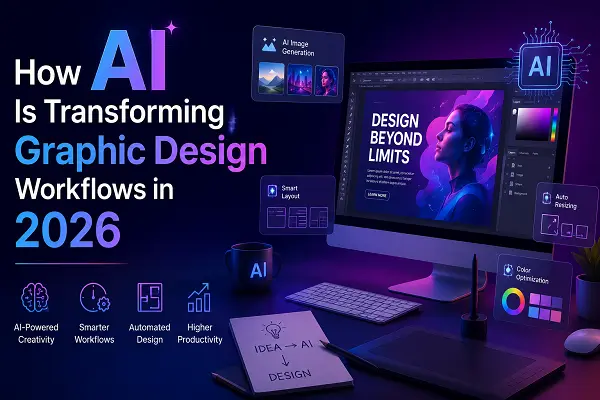
In 2026, artificial intelligence has moved beyond the status of a experimental novelty, becoming the central engine of the modern graphic design industry. The professional landscape has shifted from manual production to a high-velocity model where AI functions as a collaborative partner. This evolution allows designers to move away from repetitive, time-consuming tasks and dedicate their expertise to higher-level creative strategy, conceptual storytelling, and brand impact.
The Operational Shift Toward Agentic Workflows
The most significant change in 2026 is the emergence of agentic AI—systems that no longer just suggest changes but independently execute multi-step workflows. This transition has fundamentally altered the daily rhythm of creative teams.
-
Autonomous Asset Management: AI agents now handle routine production requirements, such as resizing assets for multiple social platforms, removing complex backgrounds, and color-grading images to match established brand guidelines.
-
Rapid Concept Exploration: Instead of starting from a blank canvas, designers now use AI to generate multiple visual territories, mood boards, and layout variations in seconds. This allows for rapid ideation and testing before a single hour of manual refinement begins.
-
System-Aware Design: Modern platforms reference a brand’s unique design system—its specific typography, spacing rules, and component libraries—to ensure that generated work is always consistent. This eliminates the “generic” look often associated with early AI models.
-
Real-Time UX Optimization: In product and web design, predictive AI models now analyze interaction patterns and heatmaps before a design is even launched. This data-driven feedback allows designers to adjust layouts proactively, minimizing drop-off points and maximizing user engagement.
Strategic Benefits of AI Integration
The integration of AI provides measurable advantages for both independent freelancers and enterprise-level agencies. By embedding these tools into the workflow, design teams can increase their capacity without compromising the quality or character of their output.
-
Increased Efficiency: Automating high-volume tasks enables designers to complete projects in a fraction of the time previously required, allowing for more projects to be handled in the same billing cycle.
-
Bridging the Designer-Developer Gap: New AI-powered tools now convert static designs into production-ready code or interactive prototypes automatically, ensuring that the final output aligns perfectly with the initial creative vision.
-
Enhanced Accessibility: Advanced AI tools allow non-technical team members to create polished, on-brand assets under the guidance of a design lead, freeing professional designers to focus on high-impact strategic tasks.
-
Data-Driven Personalization: AI enables brands to deliver hyper-personalized content at scale, adjusting visual elements and messaging for specific user segments instantly, which significantly increases conversion rates across digital channels.
Elevating Human Creativity in an Automated World
While automation accelerates execution, it simultaneously raises the bar for human taste and judgment. In an environment where generating a standard layout is instantaneous, the “human touch”—nuanced storytelling, cultural awareness, and emotional intelligence—becomes the primary competitive differentiator. The best designers in 2026 are those who act as creative directors, leveraging their deep understanding of composition and intent to guide AI systems toward more original, impactful results. By offloading technical execution, designers have rediscovered their role as architects of visual meaning.
Conclusion
The impact of AI on graphic design in 2026 is not about replacing the designer; it is about expanding the boundaries of what is possible within a creative career. By embracing intelligent automation, professionals can iterate faster, experiment more boldly, and deliver highly customized experiences. The future of the industry belongs to those who view AI as a catalyst for innovation rather than a threat, ensuring that the synergy between human intuition and machine intelligence continues to drive the next wave of visual communication.
Frequently Asked Questions
Will AI replace graphic designers by the end of 2026?
AI does not replace designers; it automates the production phase of the workflow. The industry’s value is shifting toward human strategy, creative direction, and the ability to curate AI outputs into cohesive, emotionally resonant brand experiences.
How does “vibe coding” or prompt-to-UI affect designers?
These tools allow designers to describe a vision in natural language and receive functional, editable components. This empowers designers to ship prototypes and layouts much faster, focusing on user experience rather than manual syntax or alignment.
Is AI-generated art commercially safe to use?
Most professional design platforms in 2026 utilize models trained on licensed content to ensure commercial safety. Designers should prioritize tools that provide transparency regarding data provenance and copyright support.
What is the most important skill for a designer today?
Beyond technical proficiency, the most valuable skill is “creative judgement.” Because AI can generate vast amounts of content, the ability to select, refine, and strategically apply designs to meet specific business objectives is what distinguishes top-tier professionals.
How should a small team begin integrating AI?
Start by auditing the workflow for the most repetitive, low-value tasks like resizing or background removal. Master one AI-powered tool for that specific phase before expanding to generative concepts or prototyping tools.