
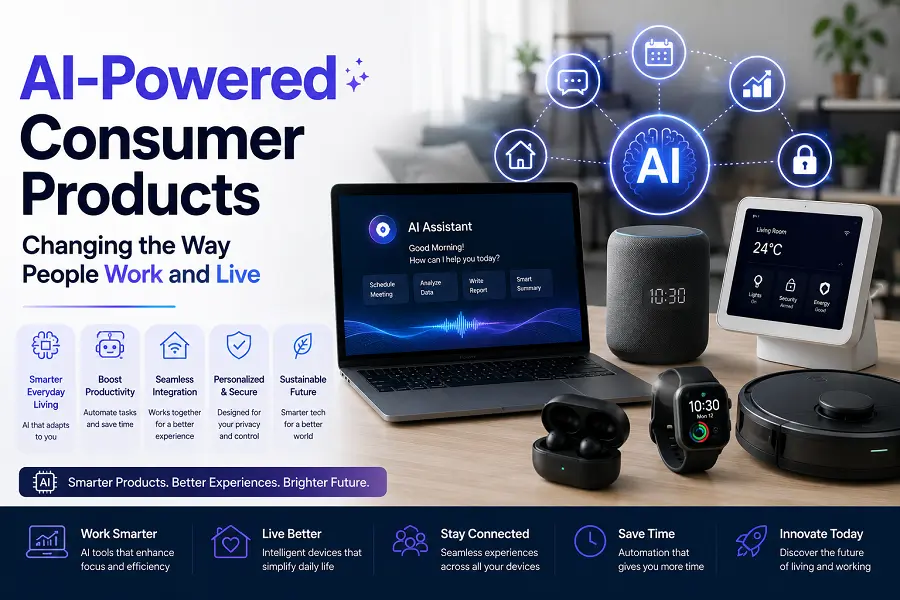
The consumer electronics landscape has shifted from passive, internet-connected utilities to active, context-aware partners. Previous generations of smart hardware depended entirely on explicit human commands, simple schedule timers, or rigid, app-based configurations. When a user wanted to adjust their environment or organize their data, they had to manually initiate the process through a smartphone screen.
Modern consumer products have permanently removed this operational friction by embracing agentic properties. Equipped with specialized neural processing hardware and multi-modal sensory frameworks, contemporary personal devices continuously observe, learn, and act in the background. By minimizing cognitive fatigue and automating administrative burdens, these intelligent products are fundamentally rewriting the dynamics of domestic living and professional productivity.
Intelligent Wearables and Personal Productivity Accelerators
The physical workplace is being optimized by a new class of discrete, screenless hardware form factors built to capture and organize critical information in real time.
-
Ambient Audio Memory Anchors: Wearable clip-on pins and smart pendants record professional meetings, utilizing natural language processing to automatically separate speakers, map conceptual branches, and generate structured action items.
-
Contextual Vision Eyewear: Advanced smart glasses integrate micro-cameras with real-time translation and object recognition engines, overlaying useful contextual data directly onto a user’s field of view without distracting from physical tasks.
-
Predictive Metabolic Rings: Ultra-slim biometric bands utilize specialized machine learning algorithms to track subtle heart-rate variability and sleep architectures, alerting users to oncoming physical fatigue or illness before symptoms manifest.
-
Intelligent Handheld Companions: Dedicated pocketsize computing units bypass traditional app grids completely, executing complex multi-step digital travel and booking itineraries through unified voice commands.
The Evolution of Ambient Intelligence Layers Within Domestic Spaces
Domestic environments are transitioning into fully automated sanctuaries where appliances no longer wait for manual configuration, but instead adjust dynamically to household behavioral patterns.
-
Generative Smart Display Hubs: Centralized household touchscreens coordinate chaotic family calendars, analyze visual kitchen inventory to suggest immediate recipes, and orchestrate diverse appliance networks using conversational speech patterns.
-
Autonomous Spatial Floor Sanitizers: Next-generation robot vacuums navigate complex floor plans using real-time machine vision, identifying specific floor textures and shifting instantly between targeted mopping pressure and vacuum suction.
-
Adaptive Climate Enclosures: Learning thermostats monitor real-time regional weather fluctuations alongside local room presence patterns, continuously adjusting thermal zones to maximize energy savings without sacrificing occupant comfort.
-
Behavioral Security Matrices: Perimeter property cameras discard simple motion alerts in favor of advanced facial and structural anomaly detection, distinguishing between expected neighborhood traffic, delivery couriers, and genuine security risks.
Collapsing the Boundary Between Professional Workspaces and Home Life
The profound transformation driven by modern AI consumer hardware lies in its ability to return unstructured time to the individual. Historically, managing a modern lifestyle required significant mental energy spent switching between professional scheduling, health tracking, and home maintenance management.
By offloading these continuous administrative choices to ambient hardware systems, consumers experience a measurable reduction in daily stress. When a wearable device smoothly logs your corporate notes, a smart hub coordinates your family’s grocery procurement, and an automated climate system manages your home energy grid, the traditional boundaries of daily friction disappear. This comprehensive technological framework allows professionals to stay completely present in their creative tasks while ensuring their personal well-being and domestic operations run with flawless machine precision.
Conclusion
The latest generation of AI-powered consumer electronics marks a permanent transition from manual digital tools to intuitive personal partners. By embedding cognitive capabilities directly into everyday objects, these innovative products optimize health, accelerate professional workflows, and establish an incredibly efficient foundation for modern living.
Frequently Asked Questions
What exactly defines an “agentic” consumer product compared to older smart tech?
Older smart gadgets merely connected to the internet to accept manual remote control, whereas agentic products utilize internal processors to evaluate real-time data and take independent actions on your behalf without waiting for a command.
How do modern AI wearables maintain strict user privacy during continuous recording?
Top-tier consumer products utilize localized, on-device neural processing units to analyze data locally, applying high-level encryption protocols before any abstract summaries are synchronized with secure cloud networks.
Do advanced AI features on consumer devices require expensive monthly subscriptions?
While basic device functionality and local processing are usually covered in the initial purchase price, advanced generative features like deep text summarization and automated calendar scheduling often require separate software subscriptions.
Can smart glasses with integrated AI safely replace standard smartphones for daily tasks?
Smart glasses excel at managing voice communications, capturing video, and displaying contextual notifications hands-free, but they complement smartphones rather than replace them for text-heavy work or complex visual media consumption.
How do modern smart home devices ensure cross-brand compatibility?
Most contemporary consumer hardware utilizes the unified Matter connectivity standard, allowing systems from Apple, Google, and Amazon to communicate seamlessly with one another across a single home network.

