
The migration from traditional enterprise platforms to artificial intelligence-driven software ecosystems marks a fundamental shift in corporate operations. Historically, business software functioned as a passive digital filing cabinet. Employees manually inputted data, generated static reports, and hard-coded rigid workflow rules. When operational variables changed, the software remained static until a human developer intervened to rewrite the underlying application logic.
Transitioning to intelligent software infrastructure fundamentally alters this dynamic. Modern business applications act as active operational partners that continuously learn from internal data patterns, real-time customer inputs, and cross-departmental workflows. For companies making the switch, this evolution eliminates fragmented processes, replaces reactive decision-making with predictive insights, and restructures how teams dedicate their time.
Immediate Impacts on Data Architecture and Workflow Velocity
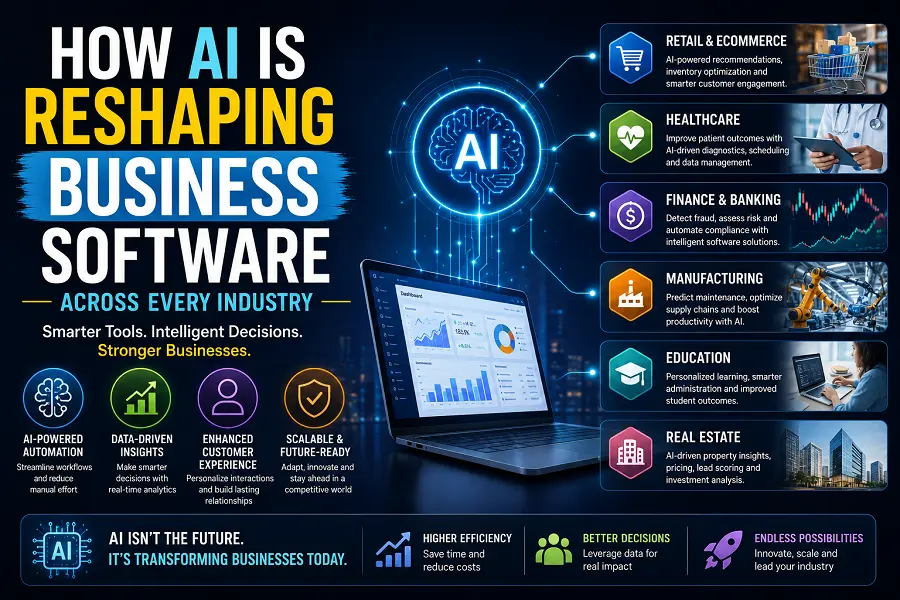
Deploying an integrated AI software layer instantly changes how information moves through an enterprise. The software unifies disconnected data repositories, transforming unorganized files into an active asset.
-
Continuous Semantic Data Integration: The software connects disparate payroll, inventory, and customer relation databases, mapping relationships between data points without requiring manual database migration.
-
Autonomous Operational Processing: Routine tasks like matching expense receipts to invoices or summarizing customer service transcripts happen instantly in the background, accelerating processing speeds.
-
Predictive Demand Forecasting: Algorithms analyze live market signals and past supply chain data to forecast inventory requirements, reducing overstock risks before warehouse issues develop.
-
Context-Aware Communication Drafting: The system studies your brand voice and historic client interactions to generate highly personalized email communications and onboarding schedules automatically.
The Structural Shift to Agentic Workflows and Intelligent Operations
Beyond accelerating administrative tasks, adopting AI-powered platforms redefines how business processes are designed and executed. Modern systems introduce autonomous digital agents capable of executing multi-step workflows with minimal human intervention.
-
Intent-Driven Execution Frameworks: Instead of manually building complex step-by-step logic loops, managers simply express a desired business outcome. The software coordinates the backend steps required to achieve that goal.
-
Cross-Departmental Task Orchestration: AI agents communicate across separate software modules, autonomously updating client data records in the CRM while triggering billing alerts inside the accounting suite simultaneously.
-
Real-Time Contextual Personalization: The platform tracks live user interactions across digital channels, modifying active promotional offers or support documentation based on immediate user intent.
-
Self-Healing System Monitoring: Smart software monitors its own operational health, automatically detecting system script errors and applying structural patches to maintain continuous runtime availability.
Recalibrating Human Roles and Corporate Decision-Making
The most profound outcome of adopting intelligent business platforms is the transformation of the daily workforce experience. When software handles repetitive data entry and basic pattern analysis, human responsibilities naturally shift toward higher-value creative and strategic tasks.
Rather than spending hours assembling spreadsheets or chasing project status approvals, managers step into the role of orchestrators and governors. They review choices generated by predictive models, handle complex edge cases that require emotional intelligence, and refine operational guardrails. This human-in-the-loop oversight ensures that while the software automates the heavy analytical lift, the company retains strict ethical boundaries and strategic alignment. The result is a leaner, more agile organization where decisions are grounded in real-time clarity rather than historical guesswork.
Conclusion
Transitioning to AI-powered business software replaces static, fragmented tools with a unified, learning ecosystem. By shifting routine workloads to autonomous agents and supplying predictive insights across every department, businesses build a resilient infrastructure designed for rapid scaling and continuous operational improvement.
Frequently Asked Questions
Does switching to AI software mean replacing your entire existing tech stack?
No. Modern AI platforms are built to deploy as an intelligent management layer over your current tools, connecting to existing databases via secure pipelines to automate tasks without requiring a total system rebuild.
How does intelligent business software protect sensitive corporate data?
Enterprise-grade AI software uses isolated cloud networks or private data frameworks, ensuring your proprietary operational metrics are kept completely secure and are never used to train public models.
What is the typical learning curve for employees adopting AI platforms?
Because AI software uses natural language interfaces, the learning curve is often shorter than traditional software. Employees type or speak commands conversationally instead of navigating complex, multi-layered nested menus.
Can AI business tools operate reliably in highly regulated industries?
Yes. Modern platforms feature comprehensive governance logs that record every automated action, providing clear audit trails that help teams track compliance in fields like finance, tax, and human resources.
What happens if an autonomous AI agent makes an operational error?
Intelligent workflows are built with strict human-in-the-loop guardrails. For high-risk decisions, the software flags anomalies and pauses execution, passing the task to a manager for final validation and adjustment.