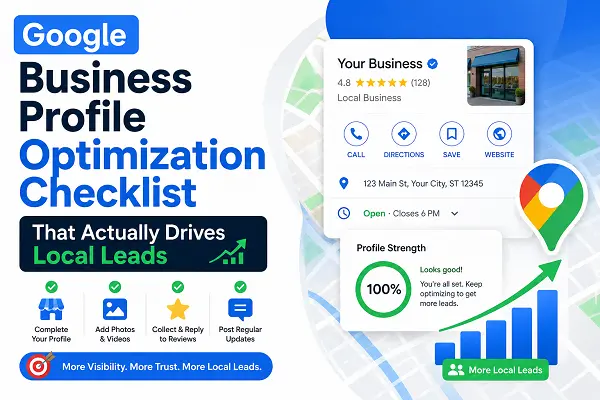
A Google Business Profile (GBP) is the bridge between local searches and physical storefronts. Merely claiming a listing does not guarantee visibility. True optimization requires feeding Google’s local algorithm specific data points that prove relevance, proximity, and trust. This actionable checklist transforms a stagnant profile into a customer-generating asset.
1. Core Profile Architecture: Building the Foundation
The foundational elements of a listing signal exact intent to search engines. Accuracy here prevents algorithmic suppression and listing suspension.
-
Consistent NAP Data: Match the business name, address, and phone number perfectly across the web, including government registrations, social profiles, and utility bills.
-
Strategic Category Selection: Select one precise primary category that describes the core business model. Utilize up to nine secondary categories to capture tangential services without diluting relevance.
-
Geo-Targeted Service Areas: Define explicit service regions by zip code or city names instead of a broad radius to prevent ranking dilution in competitive outer rings.
-
The Single Source of Truth URL: Link directly to the primary homepage, or use a clean location-specific landing page for multi-branch organizations. Append UTM tracking codes to measure organic conversions accurately.
2. Advanced Signal Optimization: Capturing High-Intent Traffic
Once the foundation is secure, layering rich data signals helps a business capture users ready to make immediate purchasing decisions.
-
Draft a Hyper-Local Business Description: Write a 750-character summary focusing on unique selling propositions and localized landmarks. Avoid generic sales copy; prioritize clarity and contextual search terms naturally.
-
Deploy the Products and Services Editors: Populate these individual tabs with structured data. Map out precise pricing, detailed specifications, and primary benefits for every core offering.
-
Activate Native Communication Channels: Enable Google Messages and configure instant automated responses. Fast reply times trigger positive behavioral signals within local search ecosystems.
-
Incorporate Attributes and Amenities: Tag the listing with specific operational attributes like “Black-owned,” “Wheelchair accessible,” or “Online appointments” to match niche search filters.
3. Trust Mechanics: Generating Ongoing Local Authority
Search algorithms prioritize active businesses that engage with their community. Continuous optimization signals a high-quality user experience.
High-resolution visual assets provide direct proof of a business’s daily operations. Upload interior, exterior, and team photos weekly to build immediate consumer confidence.
Implement a systematic review acquisition strategy. Direct responses to every review—both positive and negative—should incorporate contextual keywords describing the specific service provided. This practice builds topical authority while showing prospective clients a dedication to service standards. Finally, utilize the updates feature to publish weekly offers, events, and helpful insights, treating the profile like a localized micro-blog.
Conclusion
Optimizing a Google Business Profile is an active marketing discipline rather than a one-time administrative chore. By structuring core data accurately, maximizing interactive features, and cultivating user trust signals, local businesses can secure sustainable placements in the local map pack.
FAQs
How long does it take to see ranking improvements after optimization?
Initial adjustments to core data can reflect in local searches within a few days. Significant movements into competitive local map packs typically require four to eight weeks of consistent review acquisition and photo updates.
Can a business rank well without a physical storefront?
Yes. Service-area businesses that hidden their physical addresses can rank effectively by specifying precise service boundaries and building heavy local relevance through reviews and localized website content.
Do keywords in review responses actually impact local SEO?
Review responses do not directly boost rankings, but the text within user-generated reviews heavily influences Google’s understanding of a business. Responding with context reinforces topical authority for potential customers.
What causes a Google Business Profile to get suspended?
Suspensions usually stem from sudden changes to core NAP data, using a P.O. Box or virtual office address, stuffing promotional keywords into the business name field, or managing multiple listings for a single location.
How often should new photos be uploaded to the dashboard?
Adding two to three authentic, unedited photos every week keeps the profile active. This frequency signals ongoing operations to the algorithm and provides fresh visual proof to consumers.