
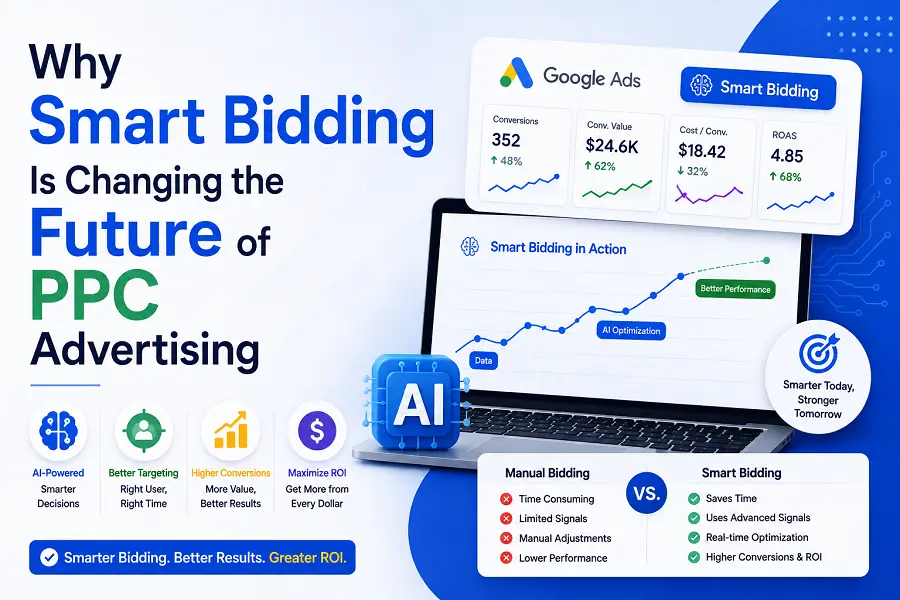
Manual bidding in pay-per-click (PPC) campaigns is quickly becoming a legacy practice. As search intent grows more fragmented and user journeys become multi-layered, advertisers can no longer manually adjust keyword bids fast enough to optimize performance. Smart Bidding relies on machine learning to evaluate millions of signal combinations in real time, shifting the focus of paid media from basic keyword matching to intent-driven business outcomes.
1. The Mechanics of Real-Time Auction Signals
Smart Bidding uses “auction-time bidding,” meaning bids are calculated dynamically for every single search query. Unlike manual adjustments that rely on historical data patches, automated systems analyze immediate contextual factors to determine the value of a click before the ad enters the auction.
-
User Intent and Query Context: Machine learning models evaluate the precise wording, syntax, and phrasing of a search query rather than relying strictly on keyword match types.
-
Cross-Device Behavior: The algorithm tracks how users transition between mobile, desktop, and tablet devices, tailoring the bid to the device most likely to convert at that specific hour.
-
Geographic and Locational Precision: Bids adjust based on a user’s exact proximity to a business location, including the distinct commercial characteristics of their neighborhood.
-
Temporal and Seasonal Factors: Automated bidding reads patterns related to the day of the week, time of day, and sudden external market trends to capture high-value traffic periods.
2. Advanced Performance Frameworks and Campaign Goals
Transitioning away from manual controls requires selecting an algorithmic strategy aligned with distinct business outcomes. Modern marketing setups utilize machine learning to target specific financial metrics rather than simple traffic volume.
-
Target Return on Ad Spend (tROAS): This strategy assigns varying values to distinct conversion actions, maximizing revenue by bidding aggressively on users predicted to make high-ticket purchases.
-
Target Cost Per Acquisition (tCPA): The system maintains a stable average acquisition cost by automatically avoiding highly competitive auctions that yield low-converting traffic.
-
Maximize Conversions: This framework prioritizes raw volume, exhausting the designated daily budget to pull in the highest possible number of leads or sales, regardless of individual acquisition costs.
-
Maximize Conversion Value: Ideal for e-commerce platforms with fluctuating cart sizes, this setting instructs the engine to pursue baskets with higher profit margins rather than individual transaction counts.
3. Data Requirements and Strategic Oversight
Automation changes the daily role of a PPC manager from administrative execution to high-level data governance. Machine learning models require clean, unfragmented data streams to perform effectively, making enhanced conversion tracking and server-side tagging absolute necessities.
Instead of tweaking individual keyword bids, digital marketers now spend their time optimizing creative assets, building comprehensive audience lists, and setting realistic budget guardrails. Feeding the system first-party data helps train the algorithm to find users who look exactly like an organization’s most profitable existing clients.
Conclusion
Smart Bidding represents a fundamental shift in how digital advertising operates. By outsourcing micro-adjustments to real-time machine learning, marketing teams can focus on strategic asset creation, message testing, and business scalability. Embracing this algorithmic evolution is no longer an optional performance boost; it is the baseline requirement for maintaining competitive visibility.
FAQs
What is the primary difference between automated bidding and Smart Bidding?
Automated bidding includes any strategy that changes bids based on basic rules or schedules. Smart Bidding is a specific subset of automated bidding that uses machine learning to optimize for conversions or conversion value in real-time auctions.
How much conversion data does a campaign need before activating Smart Bidding?
While modern algorithms can optimize with minimal historical data by leveraging global search patterns, campaigns generally achieve stability and accuracy when processing at least thirty conversions over a trailing thirty-day window.
Does Smart Bidding completely eliminate the need for PPC managers?
No. Automation changes the role from manual bid management to strategic oversight. Managers are still responsible for budget allocation, building customer audience segments, designing landing pages, and optimizing ad copy.
Can Smart Bidding handle sudden seasonal spikes or promotions?
Yes. Advertisers can utilize seasonality adjustments within the ad platform to notify the algorithm of brief, upcoming changes in conversion rates, allowing the system to bid aggressively without disrupting baseline data models.
Why do performance metrics sometimes drop immediately after enabling Smart Bidding?
Algorithms require an initialization phase, often called the learning period, to test variables and map out user behaviors. Performance typically stabilizes once the system gathers enough auction-level feedback.

