
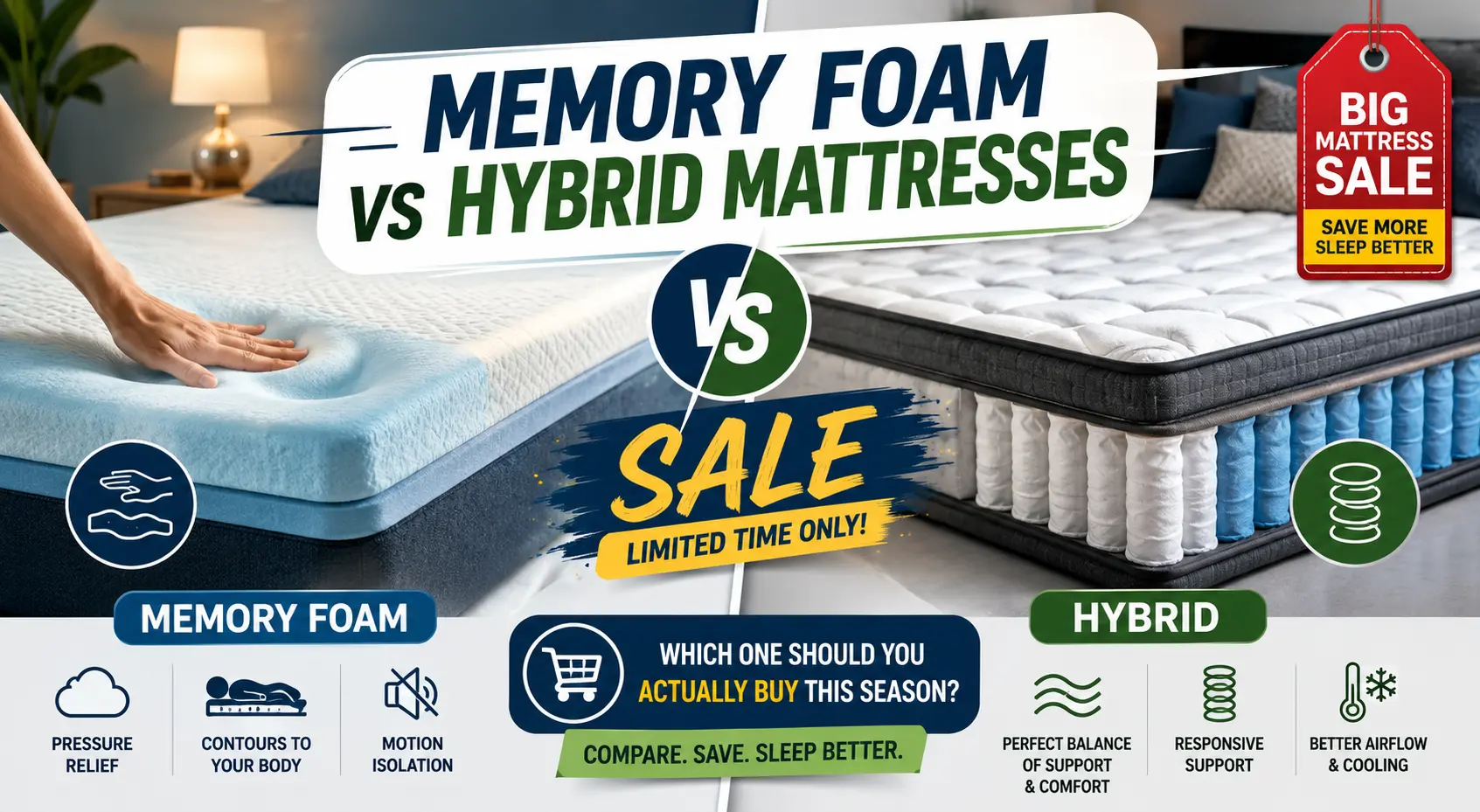
Every mattress sale season looks the same. Banners screaming “50% OFF,” salespeople pushing whatever’s overstocked, and you standing there pressing your palm into three different mattresses trying to feel a difference that, honestly, is hard to feel while wearing shoes in a showroom. I’ve been there. Last year I helped my sister pick a mattress during a Labor Day sale, and we walked into the store with zero plan and walked out two hours later more confused than when we started.
So let’s skip the confusion. If you’re trying to decide between memory foam and hybrid during a sale — when the pressure to “decide now before the deal ends” is real — here’s what actually matters.
The Quick Answer, If You’re in a Hurry
If you sleep hot, share a bed, or like a bit of bounce, go hybrid. If you deal with joint pain, sleep mostly on your side, and don’t mind a warmer bed, memory foam is usually the better pick. That’s the short version. Now let’s get into why.
Make a Table Comparing Memory Foam vs Hybrid Mattresses
This is the chart people search for most before buying, and for good reason — it’s the fastest way to see the trade-offs side by side.
| Feature | Memory Foam Mattress | Hybrid Mattress |
|---|---|---|
| Feel | Slow-sinking, body-hugging | Springy, “on top of” feel |
| Support core | All-foam layers | Pocketed coils + foam comfort layer |
| Motion transfer | Very low (good for couples) | Low to moderate |
| Temperature | Tends to sleep warm | Sleeps cooler, better airflow |
| Edge support | Weaker, softer edges | Stronger, easier to sit on the edge |
| Durability | 7–10 years with good care | 6–8 years on average |
| Price during sales | Often the better deal | Usually pricier, even on sale |
| Best sleeping position | Side sleepers, joint pain | Back and combo sleepers |
| Bounce | Minimal | Noticeable |
If you’re specifically comparing options at a mattress sale, don’t just look at the sticker price — check the coil gauge and foam density (more on that below), because a “70% off” hybrid with 6-inch coils isn’t actually a deal.
Why the “Sale” Part Actually Matters
Here’s something most comparison articles don’t tell you: mattress pricing is one of the most inflated categories in retail. That “original price” crossed out on the tag? It’s often never been sold at that price. So when you’re browsing a memory foam vs hybrid mattresses sale, the discount percentage means almost nothing on its own.
What matters is the actual spec sheet. For memory foam, check the density — anything under 3 lbs/cu ft tends to break down faster and lose support within a couple of years. For hybrids, look at coil count and gauge (lower gauge number = thicker, sturdier wire). A hybrid with 800+ pocketed coils in a queen size is generally a solid pick; anything drastically lower and you’re probably paying hybrid prices for foam-mattress performance.
Memory Foam: Who It’s Actually Good For
I switched to a memory foam mattress about four years ago after dealing with shoulder pain from sleeping on my side. The difference was noticeable within a week — less pressure on the joints, and I stopped waking up with a dead arm. That’s the real selling point of memory foam: pressure relief.
But it’s not perfect. Foam holds heat. Even the “cooling gel” versions run warmer than a hybrid, especially in a room without AC. And getting out of bed feels different too — there’s a slight sinking, slow-response feel that some people love and others find borderline annoying, especially early on.
Good for: side sleepers, people with joint or back pain, anyone who wants minimal motion transfer with a partner.
Not great for: hot sleepers, people who want to sit on the edge of the bed comfortably, anyone who dislikes a “stuck in the mattress” feeling.
Hybrid: Who It’s Actually Good For
Hybrids exist because pure memory foam wasn’t working for everyone — mainly the heat retention and lack of bounce. A hybrid gives you a coil support base with a thinner foam or latex comfort layer on top. It sleeps noticeably cooler because air can move through the coil layer, and it has more responsiveness, which combination sleepers (people who shift positions a lot at night) tend to prefer.
The catch? Hybrids are usually pricier, even during a sale, because they cost more to manufacture. And the edge support that people love about hybrids can vary a lot between brands — some collapse at the edges just like foam beds, despite the coil marketing.
Good for: back sleepers, combo sleepers, couples with different temperature preferences, anyone who’s used to a traditional innerspring feel but wants some pressure relief added in.
Not great for: people who specifically want that deep, hugging pressure relief memory foam gives — hybrids just don’t sink the same way.
A Quick Reality Check Before You Buy
No mattress fixes bad posture or an old, sagging bed frame. I’ve seen people spend a thousand dollars on a hybrid during a big sale and still wake up sore — because their box spring was over a decade old and no longer supporting the mattress properly. Check your base before blaming the mattress.
Also, sleep trials matter more than the sale price. Most brands offer 90–120 night trials now. Use them. Your body needs a few weeks to adjust to a new mattress, memory foam especially, so don’t judge it after night two.
So, Memory Foam or Hybrid — Final Call
There’s no universal winner here, and anyone telling you there is probably selling something. If I’m being honest, I’d lean hybrid for most people because it’s the safer middle ground — cooler, bouncier, easier to get in and out of. But if pressure relief is your main issue, memory foam still does that job better than anything else on the market.
Whatever you pick, buy during a real sale event (Presidents’ Day, Memorial Day, Labor Day, and Black Friday tend to have the actual best pricing), check the trial period, and don’t let a countdown timer on a website rush your decision.
FAQs
1. Is a hybrid mattress better than memory foam?
Not universally — hybrids sleep cooler and bounce more, while memory foam gives deeper pressure relief. It depends on your sleep position and temperature preference.
2. What should I check during a memory foam vs hybrid mattresses sale?
Check foam density (memory foam) or coil count and gauge (hybrid), not just the discount percentage. Many “sale” prices are inflated from an unrealistic original price.
3. Which mattress is better for back pain?
Both can work, but medium-firm hybrids and medium-soft memory foam are generally recommended for lower back pain. It varies by individual, so a trial period helps.
4. Do hybrid mattresses sleep cooler than memory foam?
Yes, generally. The coil layer allows more airflow compared to a solid foam base.
5. How long does a memory foam mattress last?
Around 7–10 years with a quality density (3 lbs/cu ft or higher) and proper care.
6. How long does a hybrid mattress last?
Typically 6–8 years, sometimes less if the coil gauge is thin or foam layers are low quality.
7. Which is better for couples, memory foam or hybrid?
Memory foam has better motion isolation, which helps if one partner moves a lot at night. Hybrids offer more bounce and cooling, which some couples prefer.
8. Are mattress sale prices actually discounted?
Not always. Compare specs (density, coil count) rather than trusting the percentage off, since many “original” prices are marked up beforehand.
9. What’s the ideal firmness for a hybrid mattress?
Medium-firm (around 6/10 on the firmness scale) works for most sleeping positions, though side sleepers may prefer slightly softer.
10. Can I find a good hybrid mattress on a budget during a sale?
Yes, but check coil count carefully — very cheap hybrids sometimes have thin coil layers that behave more like basic foam beds.
11. Does a memory foam mattress need a special bed frame?
Not necessarily, but a solid, supportive base (slats no more than 3 inches apart, or a solid platform) is important for both foam and hybrid mattresses.
12. Is it normal to feel sore during the first week on a new mattress?
Yes, your body often needs 2–4 weeks to adjust, especially when switching mattress types. Give it time before judging comfort.
13. What’s the difference between memory foam and gel memory foam?
Gel memory foam has cooling gel beads or swirls added to help offset heat retention, though it typically still runs warmer than a hybrid.
14. Should I buy online or in-store during a mattress sale?
Online often has better sale pricing and longer trial periods; in-store lets you test the feel first. Either way, confirm the trial and return policy.
15. Which mattress type is better for hot sleepers?
Hybrid mattresses, due to better airflow through the coil layer.