Architecting a website’s content framework requires making a fundamental choice between two distinct organizational models. Digital publishers must decide whether to invest resources into interconnected content clusters or rely on highly targeted, standalone articles. As search algorithms grow increasingly sophisticated at evaluating topical context, the structural relationships between your web pages heavily dictate organic performance.
Understanding how these competing methodologies impact crawl efficiency, keyword distribution, and user engagement is essential. Choosing the right framework shapes how effectively search bots parse your site’s overall niche competence and determines your resilience against major algorithmic update shifts.
The Structural Mechanics of Content Clusters
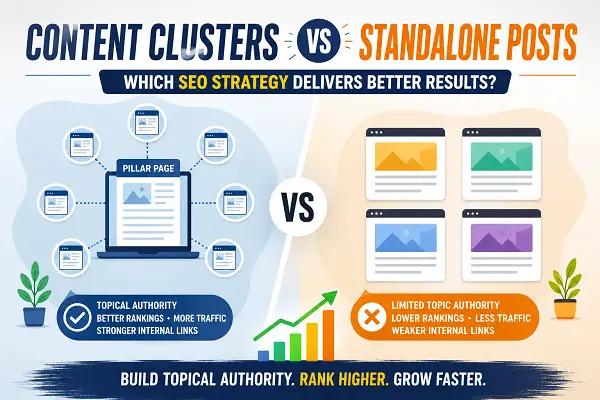
A content cluster framework relies on a centralized hub-and-spoke architecture to build undisputed topical authority. This strategy maps a broad industry subject on a comprehensive pillar page, which programmatically connects to tightly focused supporting subtopic articles.
-
Consolidated Link Equity: Internal hyperlinks flow systematically between the core pillar and supporting pages, distributing algorithmic authority smoothly across the entire domain.
-
Contextual Semantic Mapping: Grouping related subtopics closely together provides search crawlers with an explicit contextual roadmap, simplifying the indexation of complex concept patterns.
-
Elimination of Keyword Cannibalization: Clear structural boundaries divide individual intent layers across distinct URLs, preventing your own pages from competing against each other in search results.
-
Enhanced User Journey Retention: Visitors seeking deep vertical knowledge naturally follow the structural link paths, significantly increasing dwell times and reducing overall bounce actions.
The Strategic Application of Standalone Posts
Standalone posts operate as independent informational destinations designed to capture highly specific, isolated search queries. Rather than serving as part of a broader thematic matrix, these individual articles focus exclusively on exhaustive, single-topic utility.
-
Exploiting Long-Tail Keyword Gaps: Individual posts excel at target-capturing niche, low-competition phrases that do not require an entire supporting ecosystem to achieve high visibility.
-
Rapid Deployment and Agile Testing: Content teams can publish standalone pieces quickly to test market interest or react to sudden industry breaking news without altering a broader site architecture.
-
Direct Monetization and Clean Conversions: Stripping away complex internal link networks keeps consumer attention concentrated entirely on a singular call-to-action or product landing page link.
-
Lower Resource Entry Barriers: Creating a single, high-utility post demands significantly less upfront investment, planning overhead, and editorial coordination than launching an multi-page cluster.
Evaluating Performance Outcomes and Algorithmic ROI
Determining which model yields superior search results depends entirely on your domain’s competitive landscape and business lifecycle. For high-competition sectors requiring immense trust and clear verification, content clusters deliver unparalleled long-term stability by systematically proving topical depth to retrieval systems.
Conversely, newer websites or platforms entering highly specialized micro-niches can leverage standalone posts to win immediate search real estate. This tactical approach works well when search intent is entirely singular and binary. However, relying solely on unlinked pages creates structural vulnerability over time. Blending both models by treating standalone winners as eventual foundational seeds for broader clusters ensures your information architecture scales safely as search technology evolves.
Conclusion
Content clusters consistently outperform standalone posts when chasing broad topical authority and long-term algorithmic resilience. While individual articles offer immediate agility for specific terms, an interconnected cluster provides the semantic depth and structural signals that modern search systems demand for premium rankings.
Frequently Asked Questions
Which strategy is better for a brand new website?
Standalone posts are ideal for gaining initial momentum on highly specific, low-competition queries. As the site establishes foundational trust, those early winners should expand into larger content clusters.
How many supporting posts are required to build a functional cluster?
There is no fixed numerical requirement. A healthy cluster simply needs enough supporting subtopic pages to thoroughly answer all primary, natural user intents surrounding the central hub subject.
Do standalone posts hurt a website’s overall SEO health?
No, individual posts do not inherently damage visibility. However, maintaining an excessive volume of completely unlinked, isolated pages can dilute your overall crawl budget and weaken topical relevance signals.
Can a single page belong to multiple content clusters simultaneously?
To preserve strict semantic clarity and avoid confusing search crawlers, a supporting subtopic page should primarily link back to one definitive parent pillar page.
How do content clusters influence visibility within AI Overviews?
Generative retrieval systems heavily favor highly structured, node-based content networks. Clusters make it vastly simpler for extraction crawlers to parse, aggregate, and cite your data points inside automated answers.