
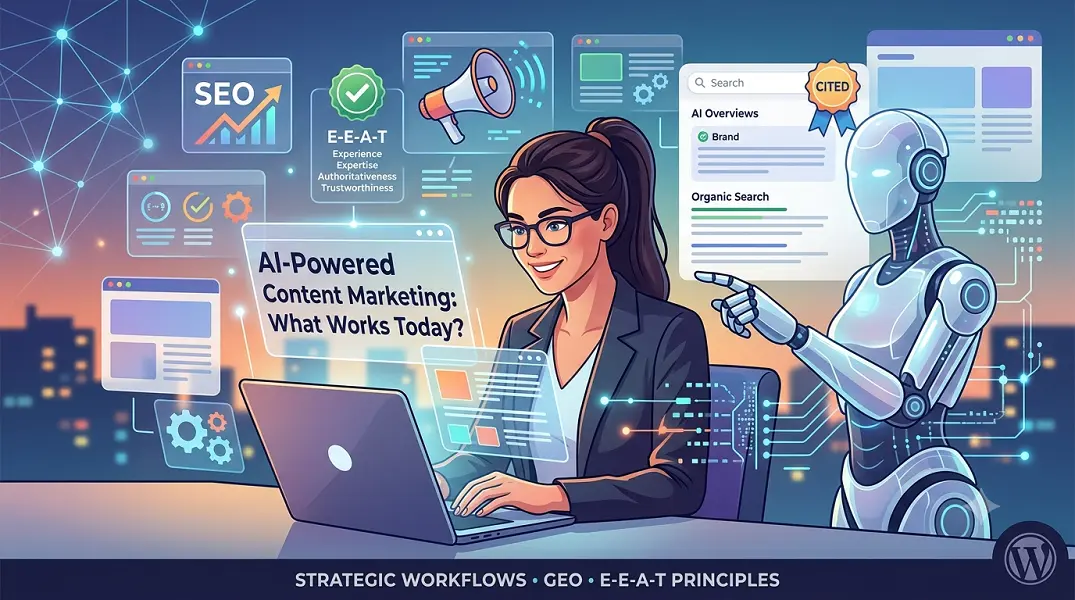
The integration of artificial intelligence into digital marketing has crossed a critical threshold. We have officially moved past the era of novelty experimentation. Today, generative AI tools are integrated into the core architecture of search engines, enterprise content management systems, and daily marketing workflows.
However, this massive democratization of content production has triggered an unprecedented crisis of commoditization. With millions of AI-assisted web pages published daily, the internet is flooded with highly articulate, perfectly grammatical, yet completely generic content.
In this hyper-saturated landscape, what actually works for AI-powered content marketing today?
To succeed in 2026, content strategies must satisfy both the scaling efficiency of generative AI tools and the strict, quality-focused filtering of Google’s ranking systems, including the latest Helpful Content core systems and E-E-A-T (Experience, Expertise, Authoritativeness, Trustworthiness) frameworks. The winning playbook is no longer about using AI to write more content; it is about using AI as an intellectual sparring partner to surface unique insights, while maintaining a strict “Human-in-the-Loop” editorial workflow.
Key Takeaways Summary
If you only have two minutes, here are the foundational pillars of successful AI content marketing today:
-
AI is the Baseline, Not the Differentiator: Over 94% of digital marketers now utilize generative AI for content creation. Because automated drafting is accessible to everyone, standard AI output has zero competitive advantage.
-
Experience is the Core Moat: Recent Google core updates heavily weigh first-hand, real-world experience. Content must offer “Information Gain”—unique data, case studies, or personal observations that an LLM cannot manufacture.
-
The Rise of GEO: Optimizing purely for standard search engine results pages (SERPs) is no longer sufficient. Marketers must optimize for Generative Engine Optimization (GEO) to ensure their brand is cited inside Google’s AI Overviews, Perplexity, and ChatGPT.
-
The Hybrid Workflow Wins: Purely manual writing is too slow to scale, while purely automated writing gets suppressed by search algorithms. The optimal path requires an AI-assisted, human-reviewed, expert-validated production pipeline.
Table of Contents
-
Generative Engine Optimization (GEO): Getting Cited in AI Overviews
-
Future Horizons: Where Is AI Content Marketing Heading Next?
1. The State of Search and AI
AI Overview Optimization Target: As of 2026, Google’s ranking systems do not penalize content simply because it was created with AI. Instead, the algorithm targets and devalues unreviewed, scaled automation that lacks original value, while actively rewarding highly comprehensive, experience-driven hybrid content.
The Evolution of the Helpful Content System
The mechanics of how search engines evaluate text have changed fundamentally. What began years ago as Google’s standalone “Helpful Content Update” has been entirely absorbed into the real-time core ranking systems. This means content is evaluated mathematically for user satisfaction, technical utility, and distinctiveness the moment it is indexed.
Furthermore, recent major core updates have actively penalised automated content networks that rely on unedited, mass-produced LLM text. Google’s algorithm uses advanced classifiers designed to identify “paraphrasing loops”—articles that merely rewrite top-ranking competitor search results without introducing any new facts to the index. If a website exhibits a pattern of publishing this type of derivative, low-value content, the system applies a site-wide sitewide classifier that can suppress the visibility of the entire domain.
Deconstructing E-E-A-T for the AI Era
Because Large Language Models are trained on existing public data, they excel at reflecting established consensus. They cannot, however, go out into the physical or digital world to run an experiment, speak to a customer, or manage a digital advertising campaign. This makes the “Experience” component of E-E-A-T your ultimate competitive defense.
| E-E-A-T Component | Traditional Interpretation | Meaning in the AI Era |
| Experience | Writing with clear clarity. | Providing verifiable proof of first-hand involvement (e.g., photos, proprietary metrics, personal case studies). |
| Expertise | Holding credentials or deep topical knowledge. | Synthesizing complex data and drawing unique, non-obvious conclusions beyond simple definitions. |
| Authoritativeness | Having a strong domain rating and external backlinks. | Becoming an established industry entity frequently referenced by other experts and cited inside LLMs. |
| Trustworthiness | Secure site architecture and accurate facts. | Total transparency regarding author background, content creation methodologies, and editorial policies. |
2. What Works Today: The Core Pillars of Success
To build an organic traffic acquisition funnel that survives algorithm adjustments and captures high-intent customers, you must design your content around three non-negotiable operational principles.
A. Focus on Maximum Information Gain
Information gain is a mathematical metric used by modern search ranking systems to measure how much new value an article offers compared to pages already indexed for that exact keyword phrase.
If your article contains the exact same headings, structural flow, and generalized advice as the top three results on Google, your information gain score is zero. To maximize this score while using AI tools, you must inject proprietary assets directly into your content briefs:
-
Internal corporate data points and performance metrics.
-
Direct quotes from internal subject matter experts (SMEs).
-
Screencasts, custom schematics, or photos demonstrating a process step-by-step.
B. Moving Beyond the Keyword to Topical Entity Networks
Modern search engines do not merely match strings of characters; they map relationships between conceptual entities (people, places, technologies, concepts).
When drafting an article on AI content marketing, for example, the algorithm expects to see a natural network of highly specific semantic entities:
[AI Content Marketing]
       │
       ├──► [Large Language Models] ──► (Context Windows, Tokenization)
       ├──► [Search Retrieval] ────────► (RAG, Vector Databases)
       └──► [Google Systems] ──────────► (E-E-A-T, Information Gain)
Instead of manually repeating a single primary keyword throughout the text, your content must comprehensively cover the sub-topics, technical components, and industry frameworks that naturally define the subject matter ecosystem.
C. Creating Specific Brand POVs
According to the latest industry data from major marketing studies, audiences are tuning out generic, vanilla brand messaging. Because anyone can generate a standard “How-To” list in seconds, growth in organic engagement is now driven entirely by distinctiveness and conviction.
Your content must take a clear stance. Avoid middle-of-the-road summaries. Share contrarian viewpoints backed by data, detail your failures as clearly as your successes, and write with an authentic, human voice.
3. The Human-in-the-Loop Editorial Framework
The most successful content marketing teams operate with a strictly managed hybrid production model. They do not use AI as a solo creator; they deploy it as a highly collaborative operational assistant.
┌────────────────────────┐      ┌────────────────────────┐      ┌────────────────────────┐
│     Human Strategy     │ ────►│  AI Research & Draft   │ ────►│ Human Line-Editing     │
│ (SME Input, Data, POV) │      │ (Structuring, Outlines)│      │(E-E-A-T Inject, Voice) │
└────────────────────────┘      └────────────────────────┘      └────────────────────────┘
                                                                            │
                                                                            ▼
                                                                ┌────────────────────────┐
                                                                │  Technical Validation  │
                                                                │ (Fact-Check, UX, Code) │
                                                                └────────────────────────┘
Here is a breakdown of how tasks are split in a modern, highly optimized content workflow:
Where AI Excels (The Scale Factor)
-
Synthesizing Unstructured Data: Processing long transcripts of internal technical interviews and converting them into clean, structured outlines.
-
Overcoming the Blank Page: Generating diverse creative angles, heading structures, and exploratory title variations based on specific parameters.
-
Format Adaptation: Converting a long, comprehensive technical whitepaper into promotional formats like email newsletters, short social summaries, or platform-specific text posts.
Where Humans Are Essential (The Quality Factor)
-
Fact-Checking and Verification: Checking names, historical timelines, code blocks, and statistical citations. LLMs routinely hallucinate plausible-sounding assertions that will completely destroy your site’s E-E-A-T.
-
Injecting Brand Identity: Polishing the rhythm of the text, removing repetitive AI filler words (e.g., “delve,” “in today’s digital landscape,” “testament to,” “revolutionize”), and ensuring the tone matches your brand guidelines.
-
Contextual Judgment: Ensuring that advice satisfies nuances specific to compliance, regional regulations, or localized market realities.
4. Generative Engine Optimization (GEO): Getting Cited in AI Overviews
Featured Snippet & AI Overview Target: To be selected as a citation source in generative answer engines, content must be structured for machine extraction. This is achieved by placing a direct, unambiguous answer block of 40–60 words immediately beneath an optimized target heading, followed by deep qualitative evidence and schema markup.
[Image demonstrating how a search engine extracts data from a structured web page into an AI Overview box]
Generative Engine Optimization (GEO) is the technical practice of designing your content so that conversational AI interfaces can easily parse, extract, and reference your pages as foundational citations.
To systematically position your content within Google’s AI Overviews, Perplexity spaces, and OpenAI search citations, you must implement the following optimization playbook:
1. Build Explicit Answer Blocks
At the immediate start of informational sections, provide a concise, high-density summary sentence. Machine models look for clear, definitions-first text blocks to pull directly into conversational summaries before diving into detailed sub-sections.
2. Implement Deep Structural Schema
Do not rely on the AI model to guess the nature of your data. Deploy explicit JSON-LD schema across your site architecture:
-
ArticleandTechArticleschema to define your authors, publishers, and publication dates. -
FAQPageschema to explicitly map out question-and-answer pairs. -
ProfilePageschema to link your individual content creators directly to verifiable professional social accounts (like LinkedIn) to validate their E-E-A-T credentials.
3. Maintain Absolute Citation Precision
When using a metric, do not write “recent research shows that software adoption is up.” State the exact statistic, name the original research organization, and provide the exact year of publication: “According to the 2026 HubSpot State of Marketing Report, 80% of digital marketers now rely on AI tools for content creation.” AI models reward explicit source attribution with premium citation links.
5. Expert Insights: Overcoming the Content Commodity Trap
To better understand how content marketing is evolving at scale, consider this analytical perspective from our senior industry strategy desk:
“The major mistake teams make is treating AI as an execution engine to replace thinkers. When you do that, you create a race to the bottom. In an era where clean, grammatical prose has a marginal cost of zero, the value of unique insights scales exponentially.
The brands winning organic visibility right now are those using their content budgets to fund primary research, deep user interviews, and proprietary experimentation. They then hand those raw, exclusive insights over to an editor armed with an AI workflow to package it beautifully. The input dictates the output. Garbage data in, garbage AI content out. Proprietary data in, industry-leading authority out.”
The “Who, How, and Why” Assessment Matrix
When auditing your content before hitting publish, evaluate it against the exact questions Google asks its human search quality raters:
-
Who created this? Is it clearly attributed to a real person with a visible bio, professional history, and domain-specific experience?
-
How was it created? Is there transparency regarding your methodology? If AI was used to process data or build diagrams, is that process clearly communicated to the reader?
-
Why was it created? Is this page built to satisfy a genuine human user query, or was it thrown together solely to rank for an affiliate keyword or high-CPC ad slot?
6. Practical Case Examples: AI Workflows That Deliver ROI
Let’s analyze two highly operational marketing frameworks that balance AI productivity with deep, human-driven authority.
Case Example 1: The B2B Enterprise SaaS Authority Playbook
A major business software provider wanted to scale its organic acquisition funnel across fifty distinct target industry terms without triggering search filter suppressions.
-
The Workflow Step 1: The internal product marketing manager recorded a comprehensive 45-minute technical conversation detailing concrete product rollouts and customer pain points.
-
The Workflow Step 2: The audio transcript was fed into an LLM with a highly specific prompt: “Extract the top 5 distinct customer engineering challenges, format them into clear H2 headers, and structure the supporting text using the specific case examples shared in the transcript.”
-
The Workflow Step 3: A senior subject matter expert reviewed the generated draft, corrected precise terminology nuances, added real screenshots of the user dashboard, and embedded custom schema.
-
The Result: The brand achieved a 42% increase in publication frequency while securing placements in Google AI Overviews for over 60% of their target high-intent search terms.
Case Example 2: The Hyper-Local Service Business Optimization
A regional transportation service company needed to build top-of-funnel helpful guides to drive bookings for regional commuter routes without relying on low-quality boilerplate text.
-
The Workflow Step 1: The team gathered authentic route data, operational scheduling bottlenecks, real customer feedback logs, and explicit localized navigation tips.
-
The Workflow Step 2: An AI copywriting engine used that structured contextual data to format highly readable travel itineraries, complete with optimized bulleted bullet points, clear tables outlining time differences, and quick answer blocks.
-
The Workflow Step 3: Local fleet operators verified the accuracy of every geographical marker and added real photos of the vehicles and routes.
-
The Result: The localized guides outranked older, generic national informational sites because the pages provided hyper-precise, verified regional utility that a global LLM could not replicate without access to the local data.
7. The Strategic Benefits and Operational Challenges
Operating an AI-powered content marketing program comes with clear trade-offs. Understanding these dynamics allows you to build a resilient, balanced operational model.
The Clear Advantages
-
Drastic Time Reductions: Marketing teams save an average of 3 to 13 hours per article by utilizing AI assistants for structural generation, research summarization, and distribution adjustments.
-
Massive Hyper-Personalization: AI makes it incredibly efficient to tailor a core content asset to multiple buyer personas or industry verticals without rewriting the entire piece from scratch.
-
Iterative On-Page Optimization: AI tools can instantly analyze an existing page against the current live SERPs to identify critical semantic keyword gaps, readability issues, and missing structural information.
The Operational Bottlenecks
-
The Hallucination Risk: Generative models operate on probabilistic text matching. They will state false statistics, non-existent software features, or imaginary legal codes with complete authority.
-
Homogenization of Brand Voice: If left unedited, AI writing trends toward a predictable, monotone cadence that fails to capture human reader attention or build long-term brand equity.
-
Saturated Distribution Channels: Because production velocity is easier than ever, standard platforms are drowning in text noise. This shifts the marketing burden heavily toward alternative distribution formats like premium video, audio podcasts, and direct email newsletters.
8. Future Horizons: Where Is AI Content Marketing Heading Next?
As we look toward the future, the boundaries of content creation and platform discovery are shifting rapidly.
The Rise of Agentic Content Pipelines
The industry is transitioning from simple interactive prompting to autonomous Agentic AI systems. Instead of a marketer manually pasting text into an engine for a single task, teams are deploying specialized networks of AI agents that communicate with one another:
┌─────────────────┐       ┌─────────────────┐       ┌─────────────────┐
│ Analytics Agent │ ─────►│ Research Agent  │ ─────►│ Drafting Agent  │
│(Tracks Traffic) │       │ (Scrapes Trends)│       │ (Builds Layout) │
└─────────────────┘       └─────────────────┘       └─────────────────┘
                                                              │
                                                              ▼
                                                    ┌─────────────────┐
                                                    │  Human Review   │
                                                    │ (Final Signoff) │
                                                    └─────────────────┘
These agentic frameworks will automatically monitor your analytics for traffic drops, research recent competitor updates, build comprehensive structural content outlines, and queue up drafts for human review with minimal manual friction.
Multi-Modal AI as the Baseline Standard
Text-only content strategies are becoming obsolete. To remain competitive, content programs must be built from the ground up as multi-modal experiences.
An authority article today must be accompanied by relevant short-form video explainers, audio versions for listeners on the go, and interactive data visualization tools. AI tools will drastically lower the cost of producing these cross-channel assets, allowing small, agile teams to run comprehensive, multi-platform media programs.
9. Frequently Asked Questions (FAQs)
Q1: Does Google penalize content written by AI?
Ans: No. Google’s official guidelines state that the use of AI or automation is not penalized as long as the resulting content is high-quality, original, and created primarily for human utility rather than to manipulate search rankings.
Q2: What is the single biggest risk of using AI in content marketing?
Ans: The loss of brand distinctiveness and trust. Unedited AI output tends to be generic, consensus-driven, and prone to subtle factual errors, which can quickly degrade your audience’s brand loyalty and your site’s E-E-A-T signals.
Q3: How do I demonstrate “Experience” if I use AI tools to draft my articles?
Ans: Provide your AI drafting assistant with raw inputs that contain proprietary value: first-hand experiment data, real-world case studies, specific screenshots, or direct quotes from certified subject matter experts.
Q4: What is Generative Engine Optimization (GEO)?
Ans: GEO is the strategic process of optimizing web content so it can be easily understood, extracted, and cited by conversational AI engines like Google AI Overviews, Perplexity, and OpenAI systems.
Q5: How long should an AI-assisted article be to rank well on search engines?
Ans: There is no fixed word count requirement. Focus instead on comprehensive intent satisfaction. Ensure your page covers every natural sub-topic, answers relevant user queries completely, and provides deeper insight than any existing competitor page.
Q6: Which AI models are best for high-quality content generation?
Ans: Advanced foundational models like OpenAI’s GPT-4o, Anthropic’s Claude 3.5 Sonnet, and Google’s Gemini 1.5 Pro are excellent options. The final quality, however, depends heavily on the specificity of your human prompts and the uniqueness of your input data.
Q7: How can I naturally remove common AI phrasing from my drafts?
Ans: Build a custom editorial style guide that explicitly bans overused AI filler words like “delve,” “moreover,” “revolutionary,” and “in conclusion.” Force your editing pipeline to focus on concise sentence structures and immediate, direct answers.
Q8: What role does schema markup play in modern AI SEO?
Ans: Schema markup acts as an explicit, machine-readable road map for search engines and AI scrapers. It clarifies relationships between authors, organizations, and concepts, directly increasing your chances of securing AI Overview citations.
Q9: Can AI tools replace human subject matter experts (SMEs)?
Ans: Absolutely not. AI models cannot experience the real world or invent new paradigms. Human SMEs are vital for providing the foundational insights, verified truths, and strategic perspectives that make content distinctly valuable.
Q10: How often should I update my AI-assisted content?
Ans: Audit your high-performing and informational content at least once every six months. Update any outdated statistics, add recent industry examples, ensure all links remain active, and refine sections to answer new related search queries.
10. Conclusion
AI-powered content marketing today is not about choosing between human creativity and machine automation. It is about orchestrating an intentional, high-performance alliance between both.
The businesses winning organic traffic and securing premium citations within generative search engines are those using AI to compress research, brain-storm structure, and streamline distribution—while investing their creative energy into generating proprietary data, capturing real-world experiences, and defending absolute factual accuracy.
As you refine your digital marketing road map, stop focusing on how many articles your team can publish each month. Shift your focus to the depth of value within each piece. Inject authentic human expertise into every single layout, protect your brand voice fiercely, and build structured, entity-driven content that clearly respects your reader’s time. That is the only sustainable path to standing out in a crowded, automated digital landscape.