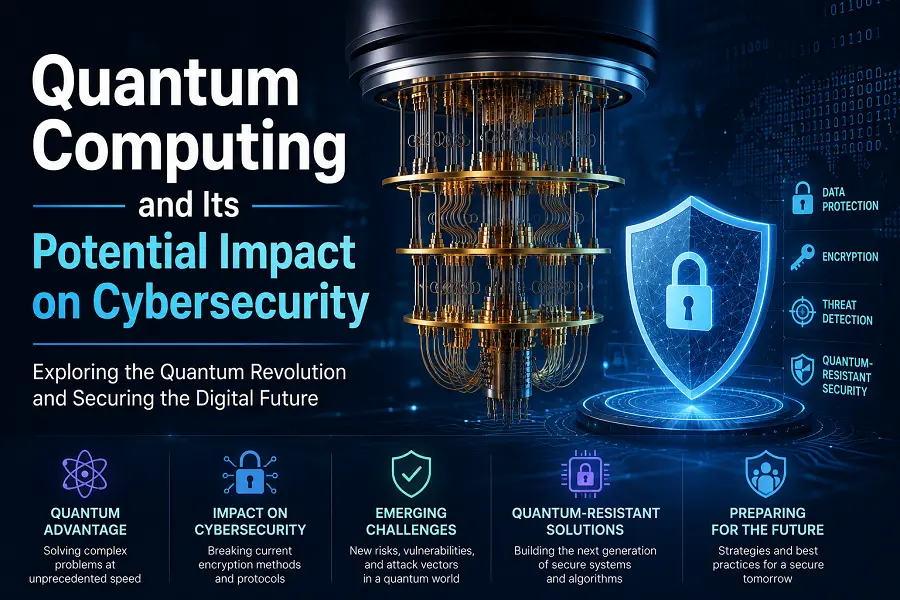
Quantum computing is no longer a theoretical concept reserved for laboratory research; it is an emerging reality that promises to revolutionize industries ranging from pharmaceutical research to logistical optimization. However, this leap in computational power introduces a profound systemic challenge to the digital world. Modern cybersecurity is built on mathematical foundations that current computers find impossible to break, but quantum systems—which operate on the principles of subatomic physics—could theoretically dismantle these protections by solving complex problems in a fraction of the time.
For businesses and government institutions, the shift toward a quantum-ready posture is now a strategic necessity. Understanding how this technology impacts your security perimeter is the first step toward building resilience against future vulnerabilities.
The Quantum Threat to Modern Encryption
Today’s digital trust relies heavily on asymmetric cryptography, including RSA and Elliptic Curve Cryptography. These systems secure web traffic, financial transactions, and digital identity frameworks by using complex mathematical problems—specifically, the factoring of large prime numbers—that would take classical computers billions of years to solve.
Quantum computers use qubits, which can exist in multiple states simultaneously, to perform massively parallel calculations. This allows them to bypass the “trial-and-error” limitations of traditional processors, potentially rendering current encryption ineffective.
-
Public-Key Vulnerability: Widely used encryption standards face the risk of obsolescence once sufficiently powerful, fault-tolerant quantum computers become accessible to adversaries.
-
Harvest Now, Decrypt Later: Malicious actors are already intercepting and storing encrypted data today. Their objective is to hold this data until quantum technology matures, allowing them to retrospectively unlock and exploit long-buried secrets.
-
Systemic Scope: The threat extends beyond web traffic; it encompasses digital signatures, secure boot processes for IoT devices, software-signing pipelines, and the very roots of trust that secure cloud services and critical infrastructure.
Strategies for Building a Quantum-Resistant Defense
As the timeline for quantum maturity compresses, organizations must transition from planning to active implementation. Building a quantum-safe infrastructure requires a multi-layered approach to cryptographic resilience.
-
Conduct a Cryptographic Inventory: You cannot protect what you cannot see. Organizations must identify every instance where public-key cryptography is embedded, including internal APIs, third-party software, firmware, and cloud identity providers.
-
Adopt Post-Quantum Cryptography (PQC): Standardization bodies have finalized new cryptographic algorithms designed to be resistant to quantum attacks. Moving to these standardized algorithms (such as ML-KEM and ML-DSA) is essential for replacing vulnerable legacy protocols.
-
Implement Crypto-Agility: Software architectures should be designed to allow for the rapid swapping of cryptographic algorithms. This flexibility ensures that as new standards emerge or older ones become compromised, systems can be updated without requiring a total infrastructure overhaul.
-
Prioritize Long-Lived Data: Systems handling data that must remain confidential for decades—such as national security archives, patient health records, and intellectual property—should be at the top of the migration list for quantum-resistant protection.
Leveraging Quantum Physics for Enhanced Security
The quantum era is not purely a threat; it also offers a breakthrough in how we secure communications. Researchers are utilizing quantum mechanics to create channels that are theoretically immune to interception.
Quantum Key Distribution (QKD) is a prime example of this innovation. Unlike mathematical encryption, QKD uses the fundamental laws of physics to share keys. If a third party attempts to intercept the key during transmission, the quantum state of the particles is disturbed, alerting both parties to the intrusion instantly. By integrating these quantum-enhanced protocols, high-security sectors can create communication paths that provide immediate detection of any eavesdropping, offering a level of physical security that current digital methods cannot replicate.
Conclusion
Quantum computing is fundamentally reshaping the cybersecurity landscape. While the risk to existing encryption is significant, it is not an immediate existential crisis for organizations that act proactively. By auditing cryptographic dependencies, adopting quantum-resistant standards, and prioritizing crypto-agility, businesses can effectively shield their critical data. Treating quantum readiness as a strategic asset rather than a technical burden will ensure your organization remains resilient in the face of future computational shifts.
FAQs
What makes quantum computers so dangerous to current encryption?
Classical computers rely on bits (0 or 1), making them slow at solving the massive math problems that protect encryption. Quantum computers use qubits that exist in multiple states, allowing them to solve those specific problems exponentially faster.
What is the “Harvest Now, Decrypt Later” threat?
It is an attack tactic where adversaries steal encrypted data now—even if they cannot read it—and store it indefinitely. They wait for the future arrival of powerful quantum computers to decrypt and expose that sensitive information.
Is all modern encryption vulnerable to quantum attacks?
Not all. While public-key encryption is highly vulnerable, many symmetric encryption methods (which use the same key for both encryption and decryption) can remain secure if key sizes are increased to withstand quantum processing speeds.
What is Post-Quantum Cryptography (PQC)?
PQC refers to new cryptographic algorithms built on mathematical problems that are currently believed to be resistant to attacks by both classical and quantum computers, providing a “quantum-safe” alternative to legacy standards.
When should a business begin their transition to quantum-safe security?
The transition should begin immediately. Because replacing deeply embedded encryption is a complex process, businesses should prioritize mapping their cryptographic footprint now to avoid critical failures later.