
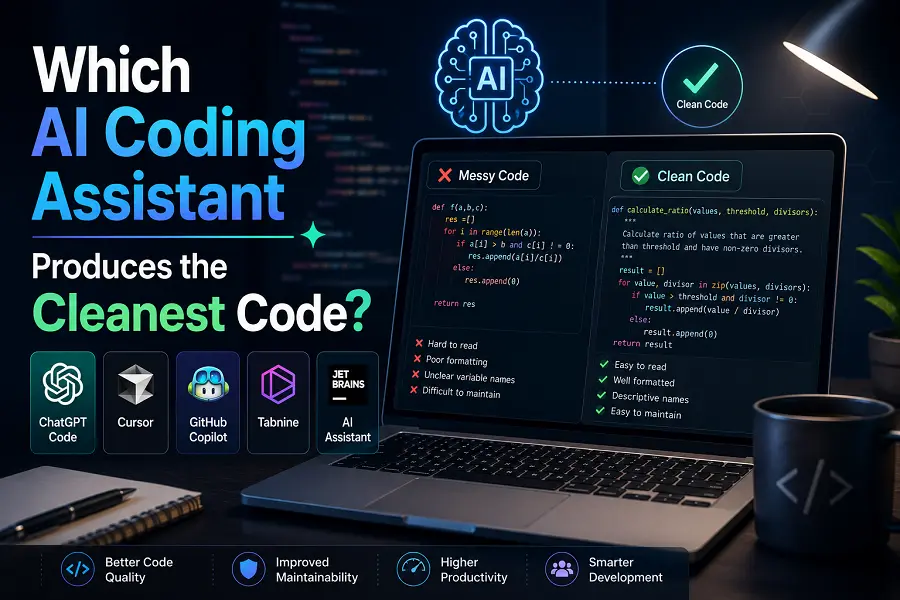
The integration of artificial intelligence into software development lifecycles has evolved far beyond basic inline autocomplete suggestions. Engineering teams are no longer evaluating tools merely by generation speed or line volume. Instead, the primary industry metric has pivoted sharply to architectural integrity and syntax precision.
When software developers deploy unvetted, messy machine code, technical debt compounds rapidly, introducing maintenance bottlenecks and security vulnerabilities. Identifying which artificial intelligence development platform produces the cleanest, production-grade output requires looking past commercial marketing claims. True cleanliness means generating predictable, self-documenting code that aligns perfectly with established design patterns and modular engineering standards.
Defining the Benchmarks of AI Code Cleanliness
Evaluating code purity generated by large language model systems depends on specific structural indicators. Machine learning engines must do more than resolve compiling errors; they must respect the physical constraints of elite software craftsmanship.
-
Adherence to SOLID Principles: High-quality assistants construct classes and modules with a singular, isolated responsibility, ensuring decoupled flexibility across complex systems.
-
Minimal Cognitive Complexity: The generated logic must avoid deeply nested conditional loops or redundant variable allocations, prioritizing absolute scannability and low maintenance friction.
-
Implicit Self-Documenting Syntax: Clean execution minimizes the need for verbose comments by outputting intuitive, unambiguous naming conventions for functions, constants, and data models.
-
Robust Algorithmic Error Handling: Production-ready output automatically encapsulates operations within proper validation layers, preventing runtime failures and memory leaks.
Comparing the Elite Code Generation Platforms
Different development assistants rely on specialized underlying reasoning models. Testing these platforms across multi-file refactoring and enterprise repository maintenance reveals distinct architectural behavior patterns.
-
Claude Code (Anthropic Ecosystem): Operating natively inside command-line environments and developer terminal setups, this tool stands out as the premium engine for logical reasoning. It processes entire repository context windows effortlessly, executing multi-file architectural overhauls with unparalleled structural clarity and minimal syntax clutter.
-
OpenAI Codex (ChatGPT Ecosystem): Running inside high-speed computing sandboxes, this cloud-native system excels at rapid, deterministic logic processing. It is highly effective for writing crisp backend algorithm scripts, setting up unit testing frameworks, and translating mathematical concepts into pristine functional modules.
-
Cursor (Independent IDE Architecture): As a deeply integrated development environment built specifically for agentic execution, this platform provides developers with an elite visual layout interface. It excels at parsing real-time interface component styling and generating clean, modular frontend state-management scripts.
-
GitHub Copilot (Pragmatic Multi-Model Engine): Acting as the universal pair-programming baseline, this system offers smooth workflows by integrating directly with standard developer editors. Its strength lies in instantaneous inline utility function completions that match a team’s existing design patterns.
Architectural Refactoring: Multi-File Code Synthesis
The ultimate test of an AI assistant’s quality is its behavior when handling large-scale code structural transformations. Minor tools routinely fragment system design by applying inconsistent paradigms across different directory folders.
Elite systems maintain strict semantic tracking across multiple files simultaneously. When executing an enterprise system migration or updating a global database schema layer, a top-tier assistant maps out the entire dependency chain before writing a line of code. It updates interfaces, modifies types, and rewrites supporting database queries while preserving identical formatting structures, type safety constraints, and architectural boundaries across your entire application framework.
Conclusion
Anthropic’s Claude Code produces the absolute cleanest, most structured code for complex backend engineering due to its superior contextual reasoning and strict adherence to design patterns. For developers prioritizing real-time frontend generation paired with fluid visual workspace workflows, the Cursor IDE serves as an equally precise alternative.
Frequently Asked Questions
Do AI coding tools introduce hidden security risks to a codebase?
Yes, unvetted automated suggestions can inadvertently incorporate deprecated dependency libraries, unvalidated input handling pathways, or vulnerable data parsing structures that fail compliance standards.
How do reasoning models minimize technical debt compared to basic autocomplete?
Advanced reasoning models plan entire execution architectures across multiple system modules before outputting text, whereas baseline autocompletes simply guess the next line based on local token patterns.
Can an AI coding assistant learn a company’s proprietary style guidelines?
Yes, deploying a specialized project configuration file, such as a localized markdown rules document, allows agentic tools to parse and enforce a team’s custom formatting and architectural patterns.
Which programming languages do AI assistants generate most accurately?
AI models demonstrate maximum precision in highly saturated, strictly typed languages like TypeScript, Python, Go, and Rust, where open-source training data provides unambiguous syntax rules.
Should human developers completely stop writing boilerplate code manually?
Delegating repetitive boilerplate configurations and structural framework setups to verified automation platforms is highly efficient, allowing human engineering resources to focus entirely on core logic design.