
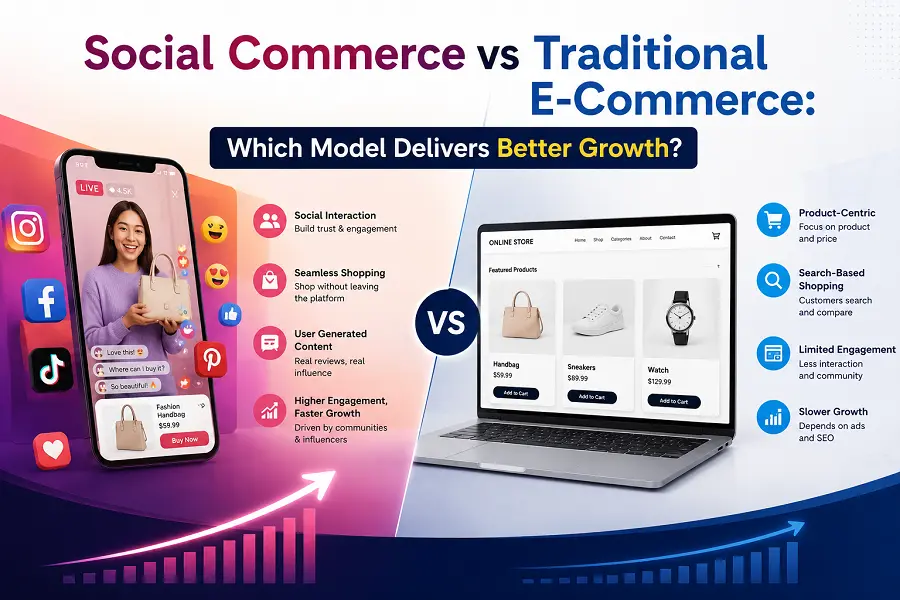
Choosing the right digital sales model determines how fast a brand scales. While traditional e-commerce relies on intentional buyers searching for specific products, social commerce catches users while they browse their feeds. Both architectures offer distinct growth mechanisms, but they scale at completely different speeds depending on your target audience.
Understanding the direct differences between these ecosystems allows businesses to allocate their marketing budgets to the channel that yields the highest conversion rates.
Core Growth Drivers of Social Commerce
Social commerce embeds the entire transaction journey directly inside networking platforms. This setup shifts the consumer experience from targeted searching to algorithm-driven product discovery.
-
Frictionless Micro-Funnels: Shoppers complete transactions without leaving their feeds. Removing external link redirects and website loading times drastically cuts cart abandonment rates.
-
Instant Social Proof: User-generated videos, interactive comment sections, and real-time community feedback act as instant trust signals right next to the purchase button.
-
Algorithmic Matchmaking: Instead of waiting for a user to type a query, predictive platform data pushes hyper-relevant product recommendations to users who match precise behavioral profiles.
-
Creator-Driven Conversions: Integrated creator affiliate networks allow trusted online personalities to demonstrate products natively, shifting advertising from intrusive banners to organic content entertainment.
Scalability Foundations of Traditional E-Commerce
Traditional e-commerce relies on dedicated standalone web stores. This model prioritizes structural ownership, deep data collection, and systematic customer lifecycle management.
-
Complete Brand Sovereignty: Independent platforms grant absolute control over web design, user experience design, and technical checkouts without third-party marketplace restrictions.
-
Unrestricted First-Party Data: Owners collect comprehensive customer data profiles, enabling highly targeted email marketing, behavioral remarketing campaigns, and predictable long-term retention strategies.
-
Search Intent Equity: Optimizing an independent store for organic keywords builds permanent search equity that captures high-intent buyers exactly when they are ready to purchase.
-
Advanced Operational Infrastructure: Dedicated backend systems allow for massive product catalog organization, complex wholesale tiering, and customized shipping configurations that social networks cannot support.
Direct Growth Comparison Across Key Metrics
Evaluating where to invest requires comparing how these setups handle capital efficiency, relationship building, and conversion metrics.
Acquisition Costs and Discovery Speed
Social networks excel at viral product discovery. A single creative short-form video can expose a brand to millions of viewers overnight without requiring a large ad spend. Traditional digital storefronts demand slow, continuous search engine optimization or immediate, expensive paid-search acquisition costs to gain comparable visibility.
Customer Lifetime Value and Retention
Standalone e-commerce sites hold the upper hand in building long-term customer relationships. Because you own the contact touchpoints, you can design automated post-purchase sequences that bring buyers back. Social commerce transactions often end up being one-off impulse buys, where the consumer remembers the app they bought it on rather than the specific brand name.
Average Order Value and Basket Sizes
Web storefronts successfully encourage cross-selling and up-selling by recommending complementary items during checkout. Social commerce favors quick single-item purchases, as the native fast-checkout formats are built to process individual products immediately from a single video or post.
Choosing the Best Path for Market Expansion
Determining the ideal sales framework depends on product categories, target demographics, and technical capabilities.
For fast-moving consumer goods, fashion apparel, beauty lines, and impulse-friendly novelty items, the social model provides a massive shortcut to revenue. Meeting younger consumer groups where they spend hours daily bypasses traditional web friction entirely.
Conversely, technical components, custom items, high-ticket luxury products, and complex business-to-business goods demand the structured, informative environment of a dedicated web store. High-investment items require deep research and multi-page technical validation before a buyer feels safe entering payment details.
Many high-growth companies ultimately deploy a hybrid approach, using social feeds as their discovery engine and their dedicated website as the operational anchor for bulk retention.
Frequently Asked Questions
Which model offers better conversion rates for new brands?
Social storefronts usually yield higher initial conversion percentages for lifestyle items because the native, single-click checkout removes multi-step navigation hurdles.
Can traditional e-commerce survive without social media integration?
While search-driven websites still capture high-intent buyers, ignoring social platforms means losing out on early-stage discovery and competitive audience reach.
How do return rates compare between the two structures?
Social sales sometimes experience slightly higher return numbers due to the spontaneous, emotional nature of impulse buying from videos.
Is social commerce secure enough for large transactions?
Major social networking apps use highly encrypted tokenized checkout integrations, though buyers still prefer dedicated corporate websites for massive financial investments.
Which system requires a larger upfront capital investment?
Building a fully optimized custom website requires higher initial web development budgets, whereas launching social shops utilizes free native platform setups.

