
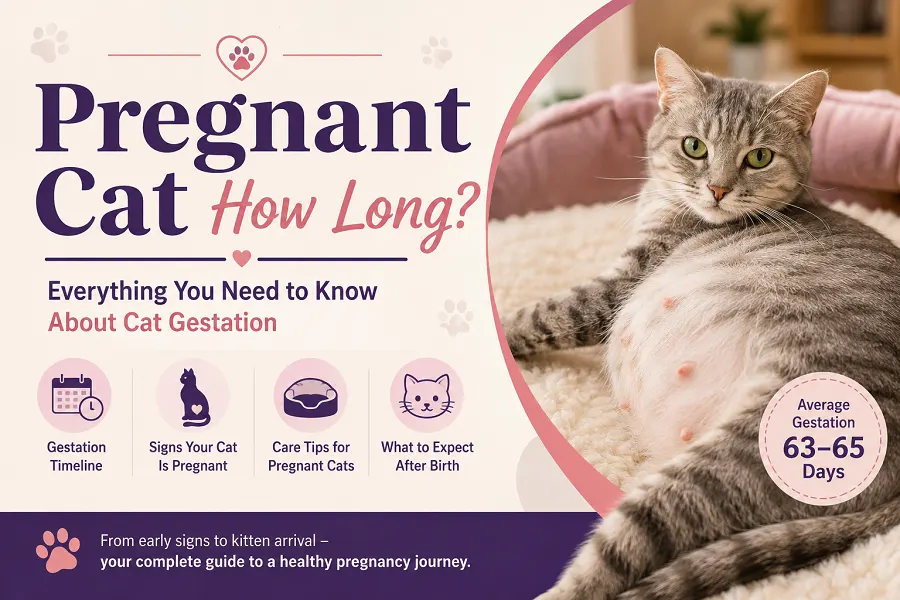
So, How Long Is a Cat Pregnant? The Short Answer First
Sixty-three days. That’s the number most vets will give you if you corner them and ask how long are cats pregnant for. But if you’ve ever actually watched a cat through a full pregnancy, you know that number is more of a suggestion than a rule. In my experience fostering cats for a local rescue, gestation ran anywhere from 61 to 69 days — and every single one of those kittens turned out perfectly healthy.
So here’s the real answer: cats are pregnant for roughly 63 to 65 days, give or take a week on either end. That’s about nine weeks, which is short compared to a dog (around 63 days too, oddly similar) or a human (nine months). If you’re asking “cat how long pregnant” because you suspect your cat is expecting and you’re trying to plan ahead, that two-month window is what you should circle on your calendar.
Now let’s get into what actually happens during those nine weeks, because the number alone doesn’t tell you much.
Why the Timeline Isn’t Exactly the Same for Every Cat
A few things push that 63-65 day window in either direction:
- Breed. Persian and other longhaired breeds sometimes run a few days longer. Siamese cats, in my experience, tend to deliver right on the early side of the window.
- Litter size. Smaller litters (one or two kittens) sometimes go a bit past day 65. Larger litters tend to arrive earlier.
- First-time vs. experienced mothers. First-time queens (that’s the technical term for a mother cat) can have slightly less predictable timing.
- How accurately the breeding date was recorded. This one trips people up more than anything else. If you didn’t witness the mating, you’re estimating — and that estimate can be off by several days.
That last point matters a lot. If you’re a rescue volunteer or you took in a stray who was already pregnant, you genuinely won’t know the exact start date. A vet can estimate gestational age through ultrasound (fairly accurate after day 21) or palpation, but it’s still an estimate, not a countdown timer.
Week-by-Week: What’s Actually Happening
I’ll be honest — for the first three weeks, almost nothing is visible from the outside. This is where a lot of new cat owners get anxious, checking their cat’s belly every day and seeing no change. That’s completely normal.
Weeks 1-2: Fertilization and implantation happen. No physical signs yet, though some cats show mild changes in appetite or become unusually affectionate.
Weeks 2-3: This is when “pinking up” happens — the nipples darken and enlarge. It’s usually the first visible clue that a cat is pregnant, and honestly, it’s more reliable than a swollen belly at this stage.
Weeks 3-4: A vet can typically confirm pregnancy by gentle abdominal palpation around day 17-25. Don’t try this yourself — it’s easy to injure the developing kittens if you don’t know exactly what you’re feeling for.
Weeks 5-6: The belly becomes noticeably round. Appetite usually increases significantly. My foster cat Maple went from eating half a can a day to nearly a full can and a half by week six, and that jump was the moment my husband finally believed me that she wasn’t just “getting chubby.”
Weeks 7-8: Nesting behavior kicks in. She’ll start scoping out closets, drawers, under-the-bed spaces — anywhere dark and enclosed. This is your cue to set up a proper nesting box now, not later.
Week 9 (days 63-65): Labor. Signs include restlessness, panting, a drop in body temperature, and repeated visits to the nest.
What If She Goes Past Day 65?
This is where a lot of owners panic, and I get it — I’ve been there. If your cat hits day 66 or 67 with no labor, don’t assume something’s wrong. But do call your vet, not the internet, at day 68 or beyond. A gestation that pushes toward day 70 does raise the risk of complications, and a vet can check fetal heartbeats and positioning to make sure everyone’s okay.
One caveat worth mentioning: sometimes what looks like an “overdue” pregnancy is just a miscounted breeding date. Cats are induced ovulators, meaning mating itself triggers ovulation, and if she mated with multiple males over several days (which happens more than people realize), your start date estimate could be off by nearly a week.
Signs Your Cat Might Be Pregnant (Before You Even Ask “How Long”)
If you’re here because you’re not 100% sure your cat is pregnant yet, look for:
- Pinking and swelling of the nipples (usually the earliest sign)
- A rounder, firmer belly appearing around week 4-5
- Increased appetite
- Weight gain of roughly 1-2 kg (2-4 lbs) over the full pregnancy
- More affectionate or, in some cats, more withdrawn behavior
- Vomiting in early pregnancy, similar to morning sickness — not common, but it does happen
If you notice these and your cat hasn’t been spayed and had access to an intact male, a vet visit is worth it. Confirming pregnancy early lets you plan nutrition and prepare properly, rather than scrambling in week eight.
Caring for a Pregnant Cat: What Actually Helps
A few practical things that make a real difference, based on what worked with the cats I’ve fostered:
- Switch to kitten food gradually starting around week 4-5. It’s calorie-dense and supports the increased nutritional demand. Don’t switch abruptly — mix it in over a week to avoid stomach upset.
- Skip unnecessary vaccinations and medications during pregnancy unless your vet specifically clears them. Some are genuinely unsafe for developing kittens.
- Set up the nesting box by week 6, not week 8. Cats like to “practice” in their space before delivery, and giving her time to get comfortable with it reduces the chance she picks a spot you don’t want — like your closet floor.
- Limit unnecessary handling in the final two weeks. She’ll be more sensitive, and too much interference near delivery can genuinely stress her out.
- Know your emergency vet’s number before labor starts, not while it’s happening. Difficult labor (dystocia) is not common, but it happens fast when it does.
A Quick Word on Spaying
I’ll say this plainly because it matters: if this pregnancy was unplanned, please talk to your vet about spaying after the kittens are weaned. Cat overpopulation is a real problem, and shelters are full of the consequences. This isn’t a guilt trip — just something worth genuinely considering once the kittens are old enough.
The Bottom Line
So, pregnant cat how long? Sixty-three to sixty-five days is the honest, working answer — with a reasonable range of 61 to 70 days depending on the cat, the breed, and how precisely you know the breeding date. It’s a short pregnancy compared to most mammals we’re used to thinking about, which means the window to prepare — nutritionally, medically, and mentally — is tighter than you’d expect. Mark the date if you can, watch for the physical signs if you can’t, and don’t hesitate to call your vet if anything feels off. Most of the time, nature handles the rest just fine.
FAQs
1. How long are cats pregnant for on average?
On average, cats are pregnant for 63 to 65 days, or roughly nine weeks, from the day of successful mating to delivery.
2. How long is a cat pregnant before you can tell?
Most visible signs, like nipple pinking, appear around week 2-3. A vet can usually confirm pregnancy through palpation around day 17-25, or via ultrasound slightly earlier.
3. How long do cats stay pregnant if it’s their first litter?
First-time mothers generally fall within the same 63-65 day range, though timing can be slightly less predictable than with experienced queens.
4. Can a cat’s pregnancy last longer than 65 days?
Yes. Anywhere up to day 67-68 is usually still considered normal. Beyond that, it’s worth contacting your vet to rule out complications.
5. How can I tell how many weeks pregnant my cat is?
Vets estimate gestational age using ultrasound (accurate from about day 21) or, later in pregnancy, by measuring fetal skull size via ultrasound or X-ray.
6. What is the earliest sign that a cat is pregnant?
Pinking — the darkening and swelling of the nipples — is typically the earliest visible sign, usually appearing around 2-3 weeks into the pregnancy.
7. Do cats show pregnancy signs like humans do?
Some do. Mild vomiting, increased appetite, and behavioral changes (more affectionate or more withdrawn) can occur, though not every cat shows obvious symptoms.
8. How long is a cat pregnant compared to a dog?
Cats and dogs have almost identical gestation periods — both average around 63 days, though individual variation exists in both species.
9. Should I change my cat’s diet during pregnancy?
Yes, most vets recommend gradually switching to a kitten formula or pregnancy-specific food starting around week 4-5 to support the increased caloric and nutritional needs.
10. How many kittens do cats typically have?
The average litter size is 3-5 kittens, though first litters and certain breeds may have fewer.
11. What should I do to prepare for my cat’s labor?
Set up a quiet, enclosed nesting box by week 6, have your vet’s and an emergency vet’s number ready, and avoid excessive handling in the final two weeks.
12. Is it safe to vaccinate a pregnant cat?
Generally, no — most vaccinations should be avoided during pregnancy unless your vet specifically advises otherwise, since some carry risks to developing kittens.
13. How do I know if my cat is in labor?
Signs include restlessness, panting, nesting behavior intensifying, a drop in body temperature, and repeated visits to the chosen nesting spot.
14. What if my cat goes past day 70 without labor?
This requires an urgent vet visit. A pregnancy pushing past 70 days without delivery can indicate complications and should not be left unchecked.
15. Can I confirm my cat’s pregnancy at home without a vet?
Not reliably. While physical signs give strong hints, only a vet can confirm pregnancy accurately and rule out other causes of abdominal swelling.