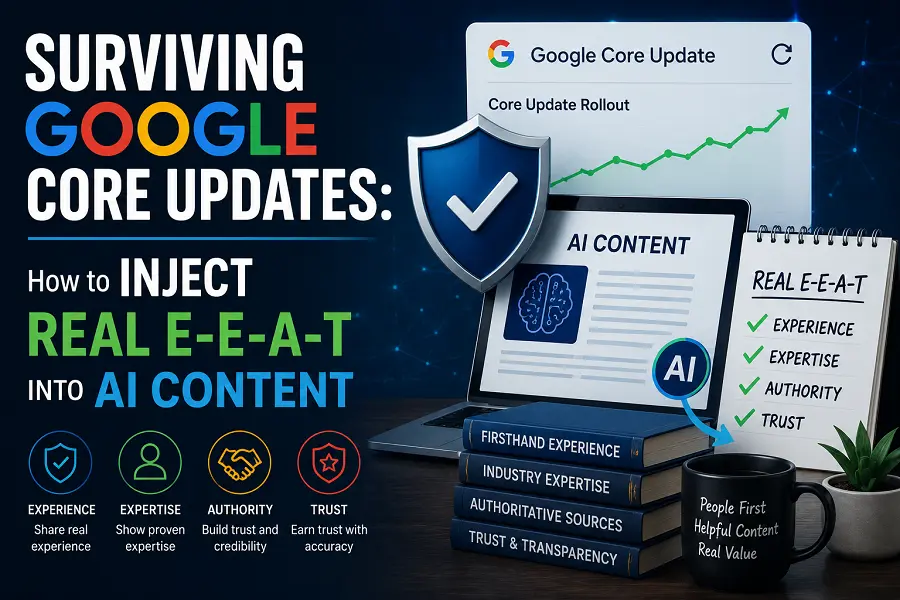

The landscape of search visibility has fundamentally shifted. Webmasters can no longer rely on publishing unedited, high-volume generative text to manipulate search engine results pages (SERPs). Following recent Google Core Updates and successive iterations of the Helpful Content System, standard generative output is systematically losing real estate to original, human-vetted insight.
When unedited AI-generated text is published verbatim, it dilutes a brand’s unique voice and directly compromises the Experience, Expertise, Authoritativeness, and Trustworthiness (E-E-A-T) signals that Google prioritizes. Google’s quality evaluation models are engineered to filter out content created at scale purely for search engine manipulation. Instead, algorithms favor high-value assets characterized by accuracy, deep structural integrity, and contextual transparency.
To survive and thrive under Google’s current ranking frameworks, marketers and SEOs must move away from generic prompt engineering and instead focus on a hybrid, human-in-the-loop workflow. This guide breaks down the precise methodology required to inject authentic E-E-A-T signals into artificial intelligence-assisted drafts, ensuring your site remains visible across both traditional Google Search and evolving AI Overviews.
The Core Update Landscape: Why AI Text Fails Without Human Intervention
AI Overview Direct Answer: Unedited AI text fails during Google Core Updates because it lacks primary source data, real-world data attribution, and first-hand human experience. Google’s Helpful Content System evaluates information for actual utility and penalizes information loops—where AI simply rephrases existing index results without contributing net-new value.
Large Language Models (LLMs) function inherently as prediction engines; they analyze patterns within historical training data to determine the most statistically probable next word. Consequently, standard AI outputs create a homogenized echo chamber. When dozens of websites use identical prompts to target the same long-tail keywords, they produce lookalike articles that offer zero unique value to a human searcher.
During recent algorithm core shifts, Google has intensified its usage of advanced classifier systems. These systems look for programmatic footprints, structural redundancy, and the absence of authentic human experience.
Structural Shifts in the Algorithmic Search Era
As research into algorithmic marketing indicates, digital visibility is undergoing three core structural shifts:
-
Hybrid Ecosystems: Value co-creation now occurs within hybrid human-AI systems where software acts as a draft generator, but humans provide the critical analytical layer.
-
Dual Brand Optimization: Digital equity must simultaneously appeal to human consumer cognition and algorithmic recommendation systems.
-
Asymmetrical Trust: Retraining search algorithms to trust your site requires consistent, error-free technical disclosures, deep topical authority, and transparent content provenance.
Transforming AI Frameworks with Generative Engine Optimization (GEO)
To rank effectively in an era dominated by AI-driven responses, websites must optimize for Answer Engine Optimization (AEO) and Generative Engine Optimization (GEO). Simply adding a few target keywords to an AI draft is insufficient. Instead, content architecture must be engineered to shape how retrieval systems cite and extract information.
Recent computer science frameworks like GEO-SFE (Structural Feature Engineering for Generative Engine Optimization) indicate that structural choices independent of semantic text significantly alter citation performance. Optimization occurs across three specific structural layers:
By formatting your AI-assisted drafts into highly scannable, structurally isolated nodes, you make it drastically easier for Google’s crawlers and generative AI models to parse, credit, and link back to your web pages as primary reference elements.
Step-by-Step Blueprint: Injecting Real E-E-A-T Into AI Drafts
The following workflow turns a standard, thin AI layout into an authoritative, human-validated document capable of weathering core algorithm adjustments.
Step 1: Infuse First-Hand Experience (The “E” in E-E-A-T)
Google added the extra “E” for Experience to distinguish between theoretical summaries and real-world execution. AI has never run a diagnostic test, spoken to a customer, or managed an enterprise budget.
-
The Action: Replace generic introductory throat-clearing (“In today’s fast-paced digital world…”) with custom field notes. Insert phrases like, “In our testing on 45 client domains during the Q1 core update, we observed a 12% drop in impressions when internal link density fell below…”
-
Visual Validation: Embed unique screenshots, proprietary data charts, or video walkthroughs showing the actual execution of the task.
Step 2: Establish Technical and Topical Expertise
An expert does not summarize top-ranking Google articles. An expert contextualizes claims using atomic facts, verifiable industry metrics, and deep vertical knowledge.
-
The Action: Audit all AI-generated assertions. Deconstruct long-tail sentences into atomic units and cross-check them against definitive industry standards. Replace vague statements with exact metrics.
-
Keyword Optimization: Integrate semantic entities—such as specialized tools, foundational methodologies, regulatory bodies, and exact industry nomenclature—naturally into the text.
Step 3: Fortify Authoritativeness Through Primary Citations
AI models regularly leverage secondary or tertiary sources, which introduces the systemic risk of compounding digital misinformation. When fact-checking and refining AI content, aim for direct primary sources.
-
The Action: Never cite a generic blog post that is merely quoting another publication. Trace the claim back to its primary origin—such as an official whitepaper, an academic research journal, or direct government database records.
-
The Execution: Use exact source quotes, attribute the data explicitly to the organization or analyst who produced it, and ensure your site’s digital footprint points outward to trusted authorities while maintaining a highly interconnected internal link framework.
Step 4: Build Trustworthiness via Structural Transparency
Trustworthiness is the most critical pillar of the E-E-A-T matrix. A site establishes trust by making its operations, authors, and data verification methods fully transparent to both search engines and human audiences.
| E-E-A-T Trust Factor | Implementation Action Requirement |
| Author Transparency | Link every article to an explicit author bio page detailing real-world credentials, historical publications, and industry certifications. |
| Editorial Transparency | Include a clear disclosure stating exactly how AI tools are used within your editorial workflow (e.g., used for structural briefs and data organization, heavily edited by human specialists). |
| Fact-Checking SOPs | Implement a rigorous human-in-the-loop review process to catch hallucinations and ensure all numbers match verified real-world disclosures. |
The Benefits and Challenges of Human-AI Hybrid Content Workflows
Embracing an edited, E-E-A-T-focused approach to AI content generation offers clear competitive advantages, but it also demands a realistic allocation of resources.
The Benefits
-
Core Update Resilience: High-quality, uniquely insightful content is consistently insulated from sudden traffic drops during core algorithm adjustments.
-
Higher AI Overview Citations: Clean structure paired with primary data increases the likelihood that your pages will be extracted as source links in generative search results.
-
Superior Conversion Rates: Real human stories and authoritative data naturally convert cold search traffic into brand advocates far better than sterile, robotic text.
The Challenges
-
Increased Editorial Overhead: True optimization requires dedicated time from subject matter experts (SMEs) to review and expand upon initial generative drafts.
-
Lower Publishing Velocity: Shifting focus from content quantity to content depth means publishing fewer total pieces, but achieving significantly higher structural impact per article.
Frequently Asked Questions (FAQs)
Does Google penalize content simply because it was written by AI?
No. Google’s official guidelines clearly state that the use of AI or automation is not penalized if it is used to create helpful, high-quality, human-first content. Google penalizes content when automation is deployed at scale to manipulate search rankings without adding original value, depth, or clear user utility.
How do search engines detect unedited AI-generated content?
Search engines do not necessarily rely on simple commercial AI detectors, which can yield false positives. Instead, they utilize complex algorithmic classifiers that analyze patterns over large volumes of text. They look for structural predictability, lack of unique entities, repetitive phrasing, and information loops that offer no distinct, non-obvious additions to the existing web index.
What is the single fastest way to add E-E-A-T to an AI draft?
The most efficient method is adding proprietary data or first-hand human observations that an AI could never generate on its own. Interview an internal subject matter expert for 10 minutes, extract their unique opinions, real-world failures, and direct case study metrics, and weave those unique insights directly into the core sections of the article.
How does site structure impact visibility in generative search engine results?
According to generative engine optimization research, macro, meso, and micro-structures heavily influence citation performance. Using clear semantic headings (H2s and H3s), isolating key takeaways into crisp bullet points, bolding core entities, and mapping data into explicit tables makes it easier for LLM-based crawlers to extract and attribute your text.
Should I disclose the use of AI on my website?
Yes, maintaining editorial transparency is a core component of building trust with your audience. A brief, honest disclosure in your editorial policy or on individual articles—explaining that AI was utilized for initial research or structural outlining while a human expert executed the primary editing, fact-checking, and final refinement—is highly recommended.