I still remember the first time a Spanish word starting with M tripped me up. I was ordering breakfast in Oaxaca, trying to ask for “more” coffee, and I said “mas” so flat that the waiter genuinely thought I was asking about something else entirely. Turns out, “más” needs that little accent mark to land right — without it, you’re just making a sound, not asking for anything.
That’s the thing about learning Spanish words that start with M: there are so many of them, and they show up everywhere — food, emotions, everyday objects, even the names of Spanish cities. So instead of giving you a random dump of vocabulary, I’ve organized this list the way I actually learned it: by how often you’ll use these words in real conversation.
Let’s get into it.
Why the Letter M Matters So Much in Spanish
Here’s something most vocabulary lists won’t tell you: M is one of the most common starting letters in Spanish because so many everyday nouns — mother, hand, world, sea — happen to begin with it. If you’re building a beginner vocabulary bank, M-words give you a disproportionate amount of practical mileage for the effort.
Also worth knowing upfront: Spanish nouns starting with M can be either masculine or feminine, and the pattern isn’t always what you’d guess. “Mano” (hand) ends in -o but is feminine — one of the classic exceptions that trips up even intermediate learners. I’ll flag exceptions like this as we go, because memorizing the wrong gender early on is a habit that’s annoying to unlearn later.
Common Spanish Words That Start With M (Everyday Vocabulary)
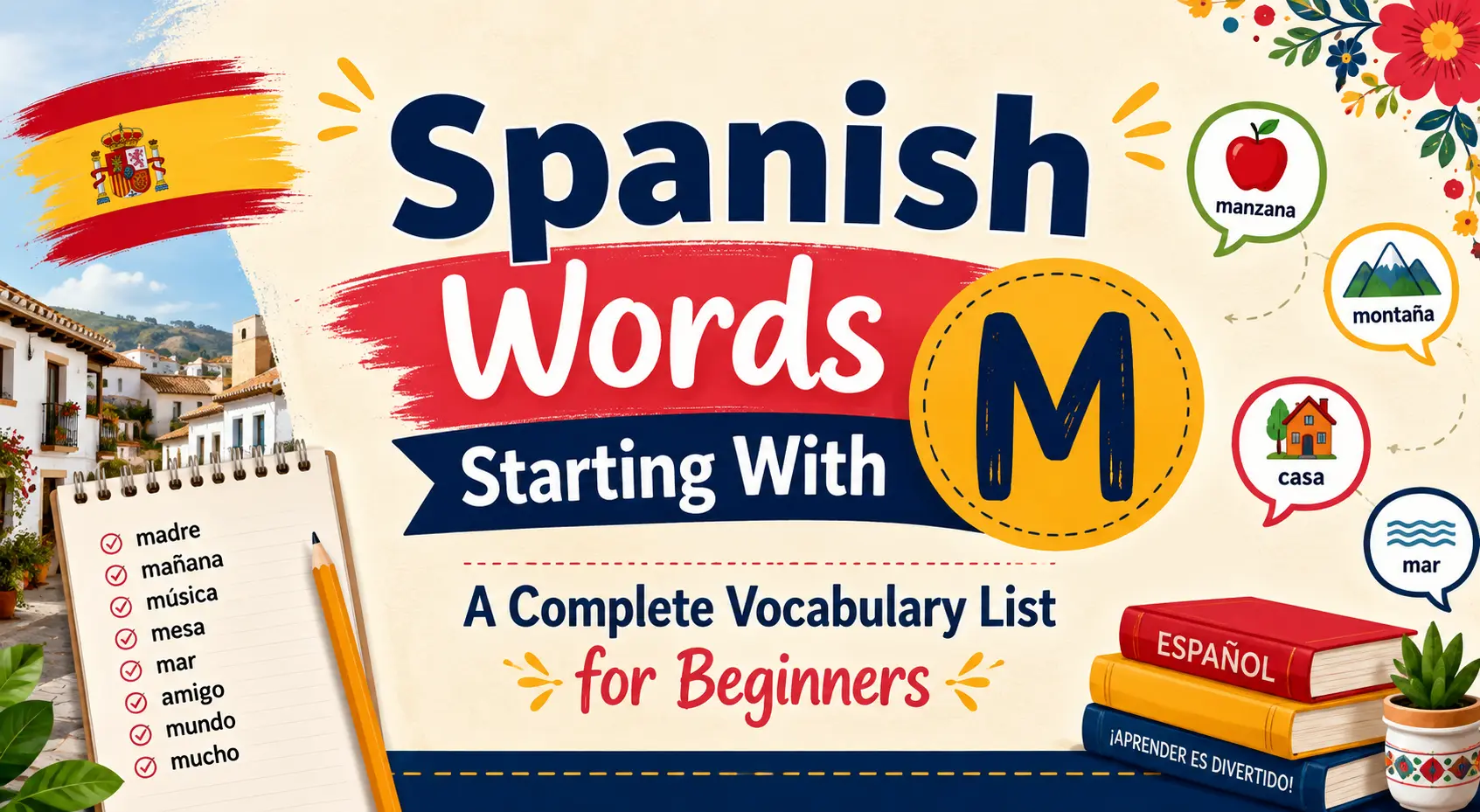
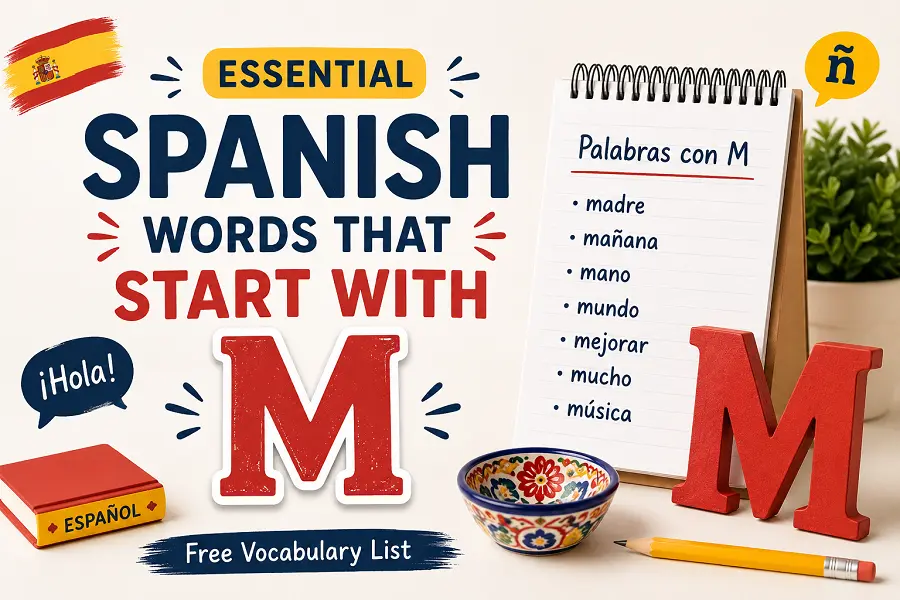
These are the M words in Spanish you’ll actually use within your first few weeks of learning:
| Spanish | English | Notes |
|---|---|---|
| madre | mother | |
| mano | hand | feminine, despite the -o ending |
| mesa | table | |
| mundo | world | |
| mujer | woman | |
| mañana | morning / tomorrow | context tells you which |
| mar | sea | can be masculine or feminine depending on region |
| minuto | minute | |
| mes | month | |
| mismo | same | |
| menos | less | |
| mucho | a lot / much | |
| más | more | don’t skip the accent |
| miedo | fear | tener miedo = to be afraid |
| momento | moment |
A quick real-world note: “mañana” is one of those words that confuses beginners because it means both “morning” and “tomorrow.” Spanish speakers rely entirely on context to sort it out, and honestly, so will you — it just takes a few weeks before your brain stops pausing on it.
Adjectives in Spanish That Start With M
Adjectives are where your Spanish starts sounding less like a phrasebook and more like a person talking. Here are the ones worth learning first:
- malo/mala — bad
- mejor — better
- mayor — older / bigger
- menor — younger / smaller
- maravilloso — wonderful
- moderno — modern
- musical — musical
- maduro — mature / ripe
- magnífico — magnificent
- misterioso — mysterious
- modesto — modest
- molesto — annoying / bothered
One thing worth mentioning: “molesto” is a classic false-friend trap for English speakers. It does not mean “molested” — it means annoyed or irritated. I’ve seen this word cause genuine confusion in language exchange chats, so it’s worth burning into memory early.
Places in Spain Starting With M
If you’re planning a trip, studying geography, or just love a good vocabulary rabbit hole, here are some well-known places in Spain starting with M:
- Madrid — the capital, obviously
- Málaga — coastal city in Andalusia, known for its beaches and Picasso’s birthplace
- Marbella — upscale resort town on the Costa del Sol
- Mallorca — the largest of the Balearic Islands
- Murcia — a region and city in southeastern Spain
- Menorca — quieter, less touristy Balearic island
- Melilla — a Spanish autonomous city on the North African coast
If you ever visit Málaga, by the way, don’t confuse it with Mallorca when booking flights — I’ve seen travelers do this, and the two places are nowhere near each other. One’s on the mainland coast, the other’s an island a few hours away by ferry.
Verbs That Start With M (Because You’ll Need Them)
Nouns and adjectives only get you so far. Here are some essential M-verbs:
- mirar — to look at
- mover — to move
- morir — to die
- mentir — to lie
- manejar — to drive / to manage (varies by region)
- mostrar — to show
- medir — to measure
- merecer — to deserve
“Manejar” is a fun one because in Mexico and much of Latin America it means “to drive,” but in Spain, people usually say “conducir” instead and reserve “manejar” more for “to handle” or “to manage.” Small regional difference, but it’s the kind of thing that makes you sound like you’ve actually spent time with native speakers rather than just a textbook.
A Few Tricky M-Words Worth Knowing
Not every word on this list is straightforward. A handful are worth extra attention:
Mal vs. Malo — “Mal” is used before a masculine singular noun (“mal día” — bad day), while “malo” is used after the noun or as a standalone adjective. Mixing these up is one of the most common beginner mistakes, and honestly, even after years of studying, I still catch myself second-guessing it sometimes.
Media vs. Medio — “Media” can mean “average,” “stocking,” or “half” (feminine), while “medio” means “half” (masculine) or “middle.” Context does a lot of heavy lifting here.
Muy vs. Mucho — “Muy” modifies adjectives and adverbs (“muy bonito” — very pretty), while “mucho” modifies nouns and verbs (“mucho tiempo” — a lot of time, or “como mucho” — I eat a lot). This is one of those rules that feels arbitrary until it just clicks one day.
How to Actually Remember These Words
Flashcards work, but they’re not the whole story. What actually helped me retain most of this list was using the words in short, dumb sentences — the sillier, the better, because you remember weird stuff more easily than neutral stuff. “El mono come manzanas en la mesa” (the monkey eats apples on the table) sticks a lot better than staring at a word list in isolation.
If you’re serious about building vocabulary long-term, try grouping words by theme instead of alphabet once you’ve got the basics down. Alphabetical lists like this one are great for a first pass, but your brain organizes language by meaning, not spelling — so after this, group “miedo,” “molesto,” and “maravilloso” together as emotion words, not just M-words.
A Quick Caveat
One honest limitation here: this list leans toward standard/neutral Spanish, and pronunciation, and even some word choices, shift depending on whether you’re talking to someone from Spain, Mexico, Argentina, or elsewhere. “Manejar” versus “conducir” is one small example, but there are dozens more across the Spanish-speaking world. Treat this as a strong foundation, not the final word — regional immersion (or at least regional content) will fill in the rest.
Frequently Asked Questions
What are some easy Spanish words that start with M? Mesa (table), mano (hand), madre (mother), and mucho (a lot) are among the easiest and most commonly used.
Are most Spanish words starting with M masculine or feminine? It’s mixed, and there are exceptions — “mano” (hand) is feminine despite ending in -o, so don’t rely on the ending alone.
What’s a good Spanish adjective starting with M to learn first? “Mejor” (better) and “mucho/mucha” (a lot) are extremely high-frequency and useful in almost any conversation.