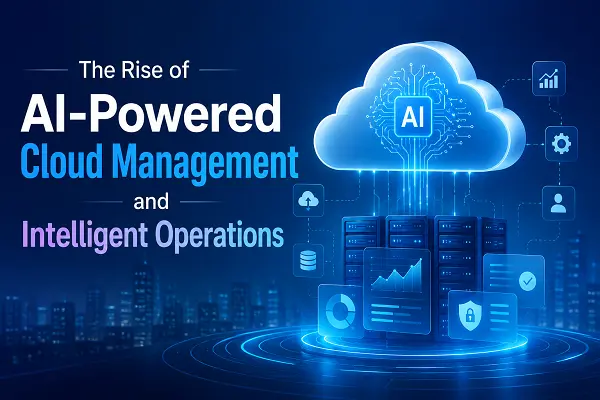
The expansion of distributed software architecture has pushed traditional cloud management beyond the limit of human cognitive capacity. Historically, IT operations relied on static threshold alerts, manual log aggregation, and reactive troubleshooting to maintain application uptime. These classic performance-monitoring paradigms required engineering teams to comb through disconnected data silos whenever an outage occurred, building complex telemetry dashboards that described what had already broken rather than preventing the failure.
Modern infrastructure demands a total departure from this manual oversight model. The introduction of artificial intelligence for IT operations, commonly known as AIOps, changes the relationship between engineers and the cloud. By embedding machine intelligence, continuous statistical telemetry analysis, and autonomous decision loops directly into cloud foundations, organizations are shifting away from manual system maintenance and moving toward fully self-managing, intelligent infrastructure environments.
The Technical Pillars of Intelligent Operational Infrastructure
The transition to autonomous cloud control relies on specific data pipelines and analytical layers that process system behavior in real time.
-
The Transition From Linear Analytics to Agentic AIOps Workflows: Legacy monitoring systems merely flagged anomalies, but modern agentic operations evaluate root causes, draft multi-step remediation plans, execute scripts, and verify system stability entirely on their own.
-
Massive Reduction in Alert Noise and System Fatigue: By applying advanced event correlation, algorithmic deduplication, and signal filtering, intelligent platforms consolidate thousands of separate error messages into a single master incident.
-
The Integration of Multi-Layered Observability Fabrics: Next-generation management platforms continuously ingest structured logs, performance metrics, and distributed microservice traces simultaneously, transforming raw telemetry into an interactive map of system health.
-
Predictive Workload Rightsizing and Capacity Planning: Intelligent operations analyze seasonal traffic patterns and historic usage curves to accurately forecast future infrastructure requirements, adjusting compute resource allocations before a bottleneck restricts performance.
Sequential Strategy for Deploying Autonomous Cloud Control
Establishing a highly resilient, self-healing cloud ecosystem requires IT leaders to follow a structured deployment path focused on data foundation and trusted automation.
-
Consolidate and Clean the Core System Observability Pipeline: Before deploying automation, engineering teams must unify their data ingestion streams, ensuring that all log files, metrics, and API traces are completely standardized across every cloud cluster.
-
Isolate Initial Machine Automation to Low-Risk Maintenance Scripts: Organizations must begin by automating predictable, well-defined operational tasks, such as clearing temporary log directories, restarting stalled non-critical services, or archiving cold data stores.
-
Bridge Siloed Functional Groups via Contextual Conversational Interfaces: Operational leaders utilize generative models to translate complex, low-level system alerts into clear, natural language summaries, allowing junior engineers and security personnel to quickly resolve incidents together.
-
Enforce Programmable Guardrails and Strict System Authorization Boundaries: Technical groups must embed explicit operational limits directly into their infrastructure-as-code frameworks, defining the exact boundaries where an autonomous agent must pause and request human authorization.
Reclaiming Human Ingenuity From Daily Production Crises
The automation of core cloud infrastructure does not replace the expertise of seasoned systems engineers; instead, it fundamentally optimizes how their time is used. In a typical manual operations framework, highly skilled engineers spend up to seventy percent of their shifts dealing with immediate production fires, investigating false alarms, and managing routine resource configurations. This persistent administrative strain drains technical talent and slows down the delivery of core product features.
Intelligent operations break this cycle by handling routine maintenance and initial incident investigation automatically. With machine systems monitoring data streams and fixing standard infrastructure errors at run time, engineers move into strategic roles focused on preventative design. Their days center on creating robust application architectures, refining long-term security postures, and optimizing software delivery pipelines, changing the role of IT from an emergency cost center into a core accelerator of business growth.
Conclusion
The rise of AI-powered cloud management marks a clear evolution away from human-driven firefighting toward true system autonomy. By building clean observability structures, scaling up automated remediation protocols, and using machine intelligence to filter out system noise, modern enterprises build highly resilient software foundations that adapt to shifting demands with minimal human friction.
Frequently Asked Questions
What differentiates traditional cloud monitoring from modern AIOps platforms?
Traditional monitoring relies on rigid, pre-set human rules to alert teams after a performance barrier is broken, whereas AIOps platforms use continuous machine learning to spot unusual patterns, trace root causes, and fix errors automatically.
How do intelligent operational systems safely reduce alert fatigue for engineers?
These systems ingest massive streams of messy log events, group related issues using event-correlation formulas, filter out redundant background chatter, and present engineers with one clear master ticket instead of hundreds of separate alerts.
Can an autonomous cloud management agent cause an accidental system outage?
Yes, if an autonomous system executes an unverified remediation script inside a complex database layout, it can trigger unintended issues, which makes setting strict operational boundaries and human-in-the-loop checkpoints absolutely essential.
How does predictive capacity planning alter standard enterprise cloud spending?
Rather than over-provisioning expensive server resources to handle unexpected traffic spikes, predictive algorithms track usage trends over time to scale resources up or down precisely when needed, eliminating wasted infrastructure spend.
What role does generative text play within modern intelligent operations?
Generative tools read complex, highly technical system crash logs and translate them into simple natural language summaries, helping support engineers diagnose system failures, draft fixes, and share incident updates across teams instantly.